

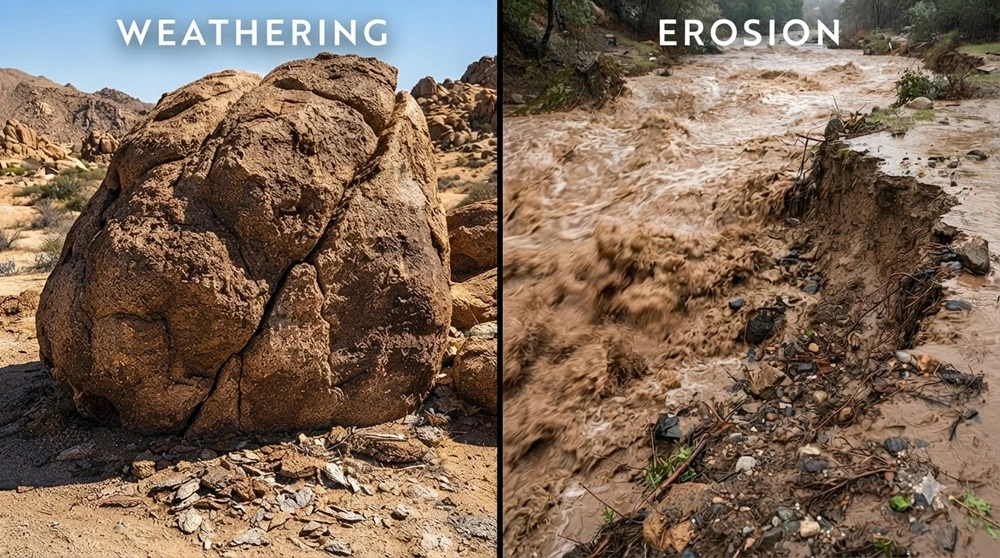
Weathering and erosion are two natural processes that affect the Earth’s surface, but they are often confused. Both play a crucial role in shaping the landscape, but they have distinct characteristics and mechanisms. Understanding these differences is fundamental to studying geology and ecology. In this article, we will explore in depth what weathering and erosion are, their types, and how they interact within the ecosystem cycle.
Weathering: Definition and Types
Weathering is the process by which rocks and minerals break down and alter in place, without significant movement of material. This process can be physical, chemical, or biological. Weathering is essential for soil formation, as it breaks down rocks into smaller particles that can be transported and transformed into fertile soil.
There are several types of weathering, each with its own characteristics. Physical weathering involves the breaking down of rocks into smaller fragments without changing their chemical composition. An example of this is the action of water that seeps into cracks in rocks, freezes, and then expands, causing the rock to crack further.
On the other hand, chemical weathering involves changes in the chemical composition of rocks. This type of weathering occurs when the minerals in rocks react with water, oxygen, and other chemical agents. An example is the formation of clays from feldspars, a process that can transform igneous rocks into soils. Finally, biological weathering refers to the action of living organisms, such as plants and microorganisms, which can break down rocks by producing acids.
Erosion: Definition and Mechanisms
Erosion, on the other hand, is the process that involves the movement of soil and rock particles from one place to another. Unlike weathering, erosion requires an external agent, such as water, wind, or ice, to move the material. This process is fundamental in the formation of landscapes, as it contributes to the creation of valleys, canyons, and other geographical features.
There are several mechanisms of erosion, the most common being water erosion , which occurs when rainwater or river water carries away soil particles. This type of erosion can be very destructive, especially in areas where vegetation has been removed. Wind erosion , on the other hand, is caused by wind carrying sand and dust particles and is common in deserts and arid areas.
Another type of erosion is glacial erosion , which occurs when glaciers move and wear away rocks and soil in their path. This type of erosion is responsible for the formation of U-shaped valleys and glacial lakes. Additionally, coastal erosion refers to the wearing away of coastlines by the action of waves and ocean currents, a phenomenon that can drastically alter the shape of the coast over time.
Key Differences Between Weathering and Erosion
One of the most important differences between weathering and erosion is that weathering does not involve movement. In weathering, rocks break down in place, whereas in erosion, material is transported to another location. This difference is fundamental to understanding how soils and landscapes are formed.
Furthermore, weathering can occur without the intervention of external agents, while erosion always requires an agent to cause the movement of material. For example, weathering can occur in a dry environment where there is no water or wind, but erosion cannot occur without these factors. This distinction is crucial for soil conservation and natural resource management.
- Weathering: The breakdown of rocks in place.
- Erosion: Displacement of particles from one place to another.
- Physical weathering: Breaking down of rocks without chemical change.
- Chemical weathering: Change in the chemical composition of rocks.
- Water erosion: Movement of particles by water.
- Wind erosion: Movement of particles by wind.
Impact of Weathering and Erosion on the Environment
Weathering and erosion have a significant impact on the environment. Weathering is fundamental to soil formation, which is essential for agriculture and plant growth. Without suitable soil, vegetation cannot grow, which in turn affects the entire food chain. Weathering also releases essential nutrients from rocks, contributing to soil fertility.
On the other hand, erosion can be harmful to the environment. Soil erosion can lead to the loss of agricultural land, which can result in decreased food production. Furthermore, erosion can cause sedimentation in rivers and lakes, affecting water quality and aquatic life. Erosion can also contribute to landslides, which can be dangerous for nearby communities.
The interaction between weathering and erosion is a continuous cycle that affects ecosystems. For example, in an area with high weathering, erosion can increase if the resulting soil is not protected by vegetation. Conversely, in areas with abundant vegetation, weathering can be slower due to the protection provided by plant roots. This balance is crucial for maintaining healthy ecosystems.
Factors Affecting Weathering and Erosion
Several factors influence the rate and type of weathering and erosion that occur in a given region. One of the most important factors is climate . In areas with high humidity and warm temperatures, chemical weathering tends to be faster, while in cold, dry climates, physical weathering may predominate. Additionally, the amount of precipitation directly affects water erosion, as heavy rainfall can cause an increase in soil erosion.
Another factor to consider is the region’s geology . Harder rocks, such as granite, are more resistant to weathering and erosion than softer rocks, such as limestone. This means that geological formations can vary in their susceptibility to these processes, which in turn affects the landscape’s topography. Mountainous areas may experience more erosion due to gravity and the slope of the land.
Finally, human activity also plays a crucial role in weathering and erosion. Deforestation, intensive agriculture, and urbanization can increase erosion by removing vegetation that protects the soil. Furthermore, agricultural practices that do not consider soil conservation can accelerate erosion and decrease soil quality. Therefore, it is essential to adopt sustainable practices to mitigate these negative effects.
Examples of Weathering and Erosion in Nature
There are many examples in nature that illustrate the processes of weathering and erosion. A classic example of weathering is the Grand Canyon in the United States, where chemical and physical weathering has broken down rocks over millions of years, creating a breathtaking landscape. The action of the Colorado River has contributed to erosion, sculpting the canyon and forming its characteristic vertical walls.
Another example of erosion is coastal erosion , which is seen on many beaches around the world. The constant action of the waves wears away the sand and rocks, which can lead to the loss of coastal land. In places like the White Cliffs of Dover in England, coastal erosion has created impressive limestone formations that are the result of the sea’s action.
Furthermore, wind erosion is a common phenomenon in desert regions . The wind can move particles of sand and dust, forming dunes and other unique landscapes. The Sahara Desert is an example of how wind erosion can shape an environment, creating a landscape of dunes and plateaus that are characteristic of the region.
Relationship between Weathering, Erosion and Climate Change
Climate change is having a significant impact on weathering and erosion processes. With rising global temperatures and changing precipitation patterns, chemical weathering can accelerate in some regions. This can lead to a greater release of nutrients into the soil, but it can also result in the breakdown of rocks and minerals more rapidly than ecosystems can adapt.
Erosion is also affected by climate change, especially in coastal and mountainous areas. Rising sea levels can intensify coastal erosion, potentially leading to the loss of habitats and agricultural land. In mountainous regions, accelerated glacial melt can increase erosion, which can result in landslides and other natural disasters.
Furthermore, extreme weather conditions, such as intense storms and prolonged droughts, can increase soil erosion. These conditions can weaken soil structure and increase runoff, leading to further loss of fertile soil. Therefore, it is essential to consider how climate change is influencing weathering and erosion when planning for natural resource management and environmental conservation.
Measures to Mitigate Erosion and Promote Sustainable Weathering
To mitigate erosion and promote sustainable weathering, several soil management practices can be implemented. One of the most effective measures is reforestation , which involves planting trees and vegetation in areas where plant cover has been lost. Plant roots help hold the soil in place and reduce erosion by absorbing rainwater.
Another important practice is conservation agriculture , which includes techniques such as crop rotation, the use of cover crops, and minimum tillage. These practices help maintain soil structure, increase organic matter, and reduce erosion. In addition, the use of natural barriers, such as terraces and ditches, can help control water flow and reduce erosion on sloping land.
Education and awareness about the importance of soil conservation are also crucial. Communities and farmers must be informed about how their practices can affect erosion and weathering. Fostering a culture of sustainability and environmental stewardship can help preserve soils and ecosystems for future generations.
Research and Advances in the Study of Weathering and Erosion
Research on weathering and erosion has advanced significantly in recent decades. Scientists are using modern technologies, such as satellite imagery and computer models, to study these processes on a large scale. This allows them to better understand how weathering and erosion affect different ecosystems and how future changes can be predicted.
Furthermore, studies are being conducted on the impact of human activity on these processes. Research on deforestation, urbanization, and climate change is providing valuable information on how our actions are affecting the environment. These studies are essential for developing effective soil management and conservation strategies.
Advances in materials science are also contributing to our understanding of weathering. Scientists are studying how different types of rocks and minerals react to specific environmental conditions. This information is crucial for understanding how soils form and how they can be effectively conserved in a changing world.
Conclusion on the Importance of Weathering and Erosion
Weathering and erosion are interrelated natural processes that play a crucial role in shaping the landscape and maintaining environmental health. Understanding their differences and impacts is essential for soil conservation and the sustainable management of natural resources. As we face challenges such as climate change and environmental degradation, it is more important than ever to adopt practices that protect our soils and ecosystems.
