

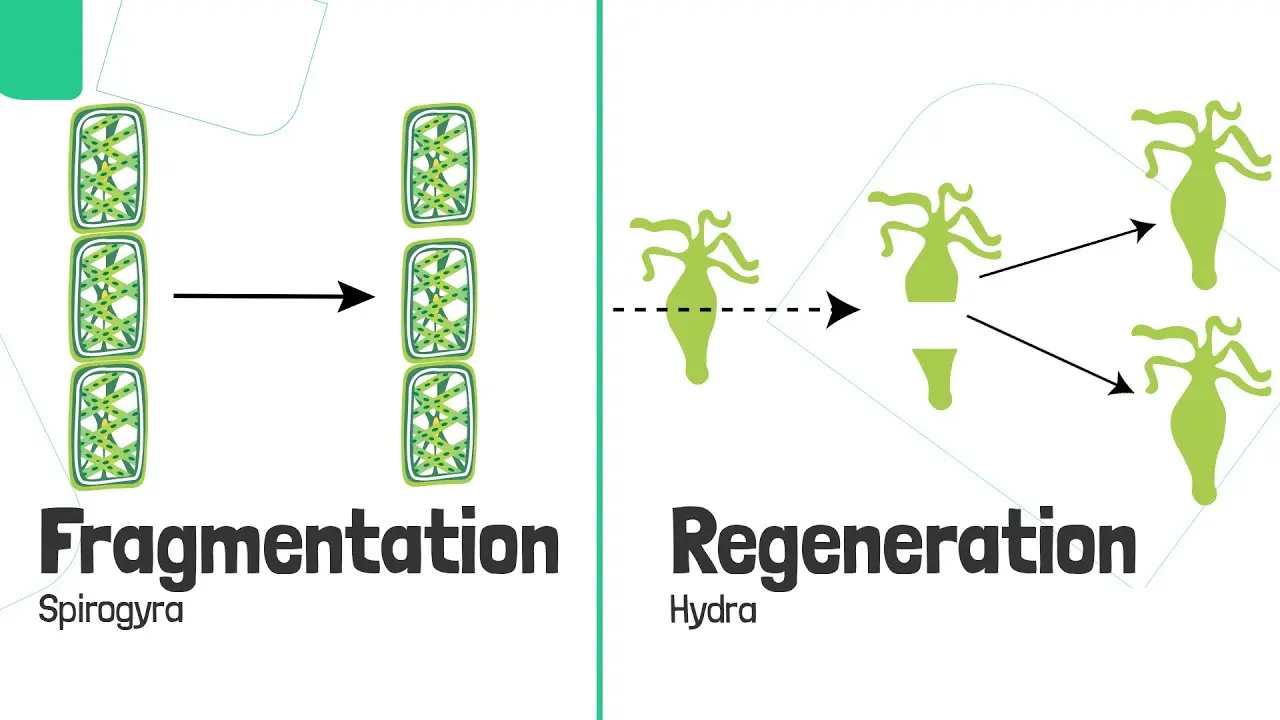
Fragmentation and regeneration are two biological processes that are often confused, but they have significant differences. Both mechanisms are related to the ability of certain organisms to recover from injury or to reproduce, but they operate in distinct ways and in different contexts. Below, we will explore each of these processes in detail, their characteristics, examples, and their importance in the natural world.
What is fragmentation?
Fragmentation is a type of asexual reproduction that occurs when an organism divides into fragments, each of which has the capacity to grow and develop into a complete organism. This process is common in various groups of organisms, including some invertebrates, plants, and certain types of fish. Fragmentation can be an effective reproductive mechanism, especially in environments where competition for resources is high.
A classic example of fragmentation is found in starfish. If a starfish loses an arm, it can regenerate that arm, but it can also happen that a fragment of the arm that breaks off from the main body develops into a new starfish. This process allows starfish not only to survive injuries but also to increase their numbers in the ecosystem. Fragmentation, therefore, not only aids individual survival but also contributes to the proliferation of the species.
Examples of fragmentation in nature
Fragmentation is observed in several groups of organisms. Some of the most prominent examples include:
- Sponges: These aquatic creatures can fragment and each fragment can grow into a new sponge.
- Planarians: These flatworms can divide into several parts, and each part can regenerate into a new, complete organism.
- Some plants: Many plants, such as cacti or succulents, can reproduce from fragments of their stems or roots.
Fragmentation not only allows for reproduction, but can also be a survival mechanism. For example, in harsh environments where predators are abundant, organisms that can fragment have a greater chance of survival, as they can escape threats by dividing into smaller parts.
What is regeneration?
Regeneration is a biological process in which an organism can repair or replace damaged or lost body parts. Unlike fragmentation, which involves creating new organisms from parts, regeneration focuses on restoring the integrity of the original organism. This process is essential for the survival of many animals, especially those vulnerable to injury or predator attacks.
Regeneration can be complete or incomplete. In complete regeneration, the organism can completely replace the lost part, while in incomplete regeneration, the new tissue may not be identical to the original. A notable example of complete regeneration is found in salamanders, which can regenerate limbs, tails, and even parts of their heart and eyes.
Examples of regeneration in nature
Regeneration occurs in a variety of organisms, including:
- Salamanders: They can regenerate limbs and internal organs with great efficiency.
- Axolotls: A type of salamander that can regenerate parts of its brain and heart.
- Starfish: Although they also reproduce by fragmentation, they can regenerate lost arms.
Regeneration is a fascinating process that has captured the attention of scientists and researchers. Understanding how regeneration works in different organisms can have significant implications for regenerative medicine in humans, where the goal is to repair damaged tissues and organs.
Key differences between fragmentation and regeneration
While both fragmentation and regeneration are recovery mechanisms, there are key differences between them. First, fragmentation results in the creation of new organisms, whereas regeneration involves the repair of an existing organism. This means that fragmentation leads to an increase in population, while regeneration results in a relatively constant number of organisms.
Another important difference is the way each process occurs. Fragmentation is usually a passive process that happens as a result of the physical breakdown of the organism, while regeneration is an active process that requires significant biological effort to mobilize cells and resources to repair damaged tissues.
Ecological importance of fragmentation and regeneration
Both processes have significant ecological importance. Fragmentation allows species to adapt and thrive in changing environments. For example, in ecosystems where resources are limited, organisms that can fragment have an evolutionary advantage, as they can colonize new areas quickly.
Regeneration, on the other hand, plays a crucial role in the resilience of ecosystems. Organisms that can regenerate parts of their bodies have a greater chance of surviving predator attacks or injuries. This not only benefits individuals but also helps maintain population balance within an ecosystem.
Studies on fragmentation and regeneration
Research on fragmentation and regeneration has advanced considerably in recent years. Scientists have been studying these processes to better understand how they work and what factors influence them. For example, it has been discovered that certain environmental factors, such as resource availability and habitat conditions, can affect an organism’s ability to fragment or regenerate.
Studies have also explored the genetic and molecular basis of regeneration. Understanding the mechanisms underlying regeneration can provide valuable insights for regenerative medicine in humans, where the goal is to repair or replace damaged tissue. Recent research has identified genes and molecular pathways that are critical for regeneration in organisms such as salamanders and axolotls.
Applications of research on fragmentation and regeneration
Research on fragmentation and regeneration is not only of academic interest but also has practical applications in various fields. For example, in biomedicine, understanding how organisms regenerate tissues can inspire new therapies to treat injuries and diseases in humans. Scientists are working on developing treatments that can stimulate regeneration in human tissues, such as skin, heart, and nerves.
Furthermore, in the field of ecology and conservation, understanding how organisms fragment and regenerate can help develop strategies for managing endangered species. Protecting organisms with a high capacity for regeneration can be crucial for maintaining biodiversity in ecosystems. Fragmentation, in turn, can be used to encourage the proliferation of species in degraded areas.
Challenges and limitations of fragmentation and regeneration
Despite their benefits, both fragmentation and regeneration present challenges and limitations. In the case of fragmentation, not all fragments can survive or develop into complete organisms. Fragmentation can also lead to a decrease in genetic diversity, since the new organisms are clones of the original, which can make the population more vulnerable to disease and environmental changes.
Regarding regeneration, while many organisms have a remarkable ability to regenerate body parts, not all tissues can regenerate efficiently. For example, humans have a limited capacity to regenerate organs and tissues, which poses challenges in medicine. Furthermore, regeneration may not be sufficient to compensate for the loss of body parts in organisms that have suffered severe injuries.
Future of research on fragmentation and regeneration
The future of research into fragmentation and regeneration is promising. As scientists continue to explore these processes, new discoveries are expected that could have a significant impact on biology, medicine, and conservation. With advances in technology, such as gene editing and synthetic biology, researchers are beginning to unlock the secrets of regeneration, which could lead to new treatments for injuries and diseases in humans.
Furthermore, research on fragmentation can provide valuable information on how species respond to environmental changes and how ecosystems can be better managed. Understanding how organisms fragment and regenerate can help develop effective strategies for the conservation and restoration of damaged habitats.
