

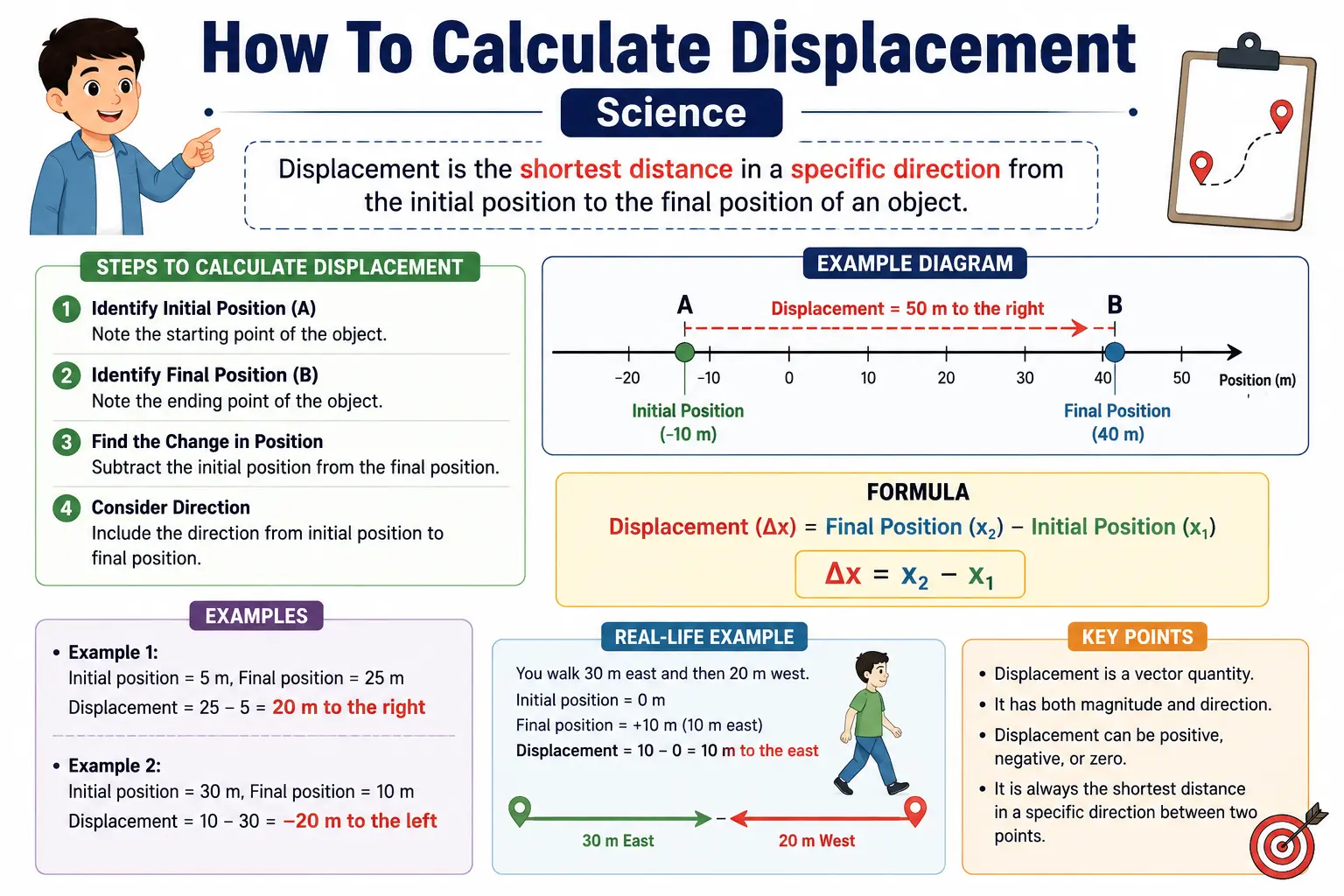
Displacement is a fundamental concept in physics that refers to the straight-line distance and direction from an initial point to a final point. Understanding how to calculate displacement is important because it allows us to effectively analyze the motion of objects. Unlike distance, which only considers the length traveled, displacement considers direction, making it a vector concept. In this article, we will explore how to calculate displacement and its importance in various situations.
Definition of displacement
To understand how to calculate displacement, we must first define what it is. Displacement can be thought of as the shortest distance between two points in a specific direction. This means that if an object moves from one place to another, the displacement is the straight-line distance between these two points, regardless of the route taken. For example, if you walk 3 kilometers north and then 4 kilometers east, your displacement is not the sum of those distances, but rather the straight-line distance from your starting point to your ending point.
Mathematically, displacement can be represented as a vector. This means it has both a magnitude and a direction. The magnitude is the length of the vector, which can be calculated using the Pythagorean theorem if we know the distances traveled in each direction. The direction can be expressed in terms of angles or relative to cardinal points. Therefore, displacement is a valuable tool for understanding motion in space.
Calculation of displacement in one dimension
Calculating displacement in one dimension is quite simple. Let’s assume an object moves in a straight line. The basic formula for calculating displacement is:
- Displacement = Final position – Initial position
For example, if a car moves from an initial position of 10 meters to a final position of 30 meters, the displacement is calculated as follows:
- Final position = 30 meters
- Starting position = 10 meters
- Displacement = 30 – 10 = 20 meters
In this case, the displacement is 20 meters in the direction of movement. It’s important to note that if the object returns to its initial position, the displacement will be zero, even though the distance traveled may be significant. This is a crucial aspect that distinguishes displacement from distance.
Calculation of displacement in two dimensions
When an object moves in two dimensions, calculating displacement becomes slightly more complex, but it remains quite manageable. To calculate displacement in two dimensions, we use the Pythagorean theorem. Let’s assume an object moves in a plane, and we know the distances traveled in the x and y directions.
The formula for calculating displacement is as follows:
- Displacement = √(Δx² + Δy²)
Where Δx is the change in position in the x-direction, and Δy is the change in position in the y-direction. For example, if a cyclist moves 3 meters north and then 4 meters east, we can calculate their displacement as follows:
- Δx = 4 meters (east)
- Δy = 3 meters (north)
- Displacement = √(4² + 3²) = √(16 + 9) = √25 = 5 meters
In this case, the cyclist’s displacement is 5 meters in a straight line from their starting point to their finishing point. Furthermore, we can also determine the direction using the angle, which can be calculated with the tangent trigonometric function.
Displacement in three dimensions
Calculating displacement in three dimensions is similar to calculating it in two dimensions, but it adds a third variable, representing the z-axis. This is useful in situations where movement occurs in three-dimensional space, such as in the case of an airplane or a drone. The formula for calculating displacement in three dimensions is:
- Displacement = √(Δx² + Δy² + Δz²)
Where Δz is the change in position in the z direction. For example, if an object moves 3 meters in the x direction, 4 meters in the y direction, and 5 meters in the z direction, the displacement would be calculated as follows:
- Δx = 3 meters
- Δy = 4 meters
- Δz = 5 meters
- Displacement = √(3² + 4² + 5²) = √(9 + 16 + 25) = √50 ≈ 7.07 meters
This shows that displacement in three dimensions is also a vector concept that takes into account both the magnitude and direction of motion. It is crucial in fields such as engineering and applied physics, where objects often move in three-dimensional space.
Practical examples of displacement calculation
To better understand the concept of displacement, it’s helpful to look at some practical examples. Imagine a runner participating in a race. If the runner starts at the starting line, runs 100 meters north, and then turns 90 degrees to run 40 meters east, what is their displacement?
First, we identify the changes in positions:
- Δx = 40 meters (east)
- Δy = 100 meters (north)
Now, we apply the Pythagorean theorem:
- Displacement = √(40² + 100²) = √(1600 + 10000) = √11600 ≈ 107.7 meters
This means that the runner’s distance traveled from the starting point to their finish position is approximately 107.7 meters in a straight line. This calculation is essential for understanding the runner’s performance in the race.
Importance of displacement in science
The concept of displacement is vital in many areas of science and engineering. In physics, for example, it is used to analyze the motion of bodies. Displacement is a key component in the equation of motion, which relates position, velocity, and time. Without a clear understanding of displacement, it would be difficult to predict the behavior of a moving object.
Furthermore, in engineering, displacement is used to design structures and systems. Engineers must consider how objects will move in relation to their structures, and calculating displacement helps them anticipate potential problems. For example, when designing a bridge, it is essential to consider the displacement of vehicles that will cross it to ensure the safety and stability of the structure.
Displacement in everyday life
Displacement also plays an important role in our daily lives. From the moment we move from one place to another, we are experiencing displacement. For example, when walking to work, the distance we travel and the direction we take determine our displacement. Understanding this concept helps us better understand our routines and plan our daily activities.
Furthermore, distance is crucial in the transportation sector. For example, when we use navigation apps, they calculate distance to provide us with the shortest or fastest route to our destination. This not only saves time but also optimizes fuel and resource use, contributing to more efficient and sustainable transportation.
Common mistakes when calculating displacement
When calculating displacement, it’s easy to make mistakes, especially if you don’t fully understand the difference between displacement and distance. A common error is to add up the distances traveled in each direction without considering the final direction. For example, if an object moves 5 meters north and then 5 meters south, the total distance traveled is 10 meters, but the displacement is zero, since the object returns to its starting point.
Another common mistake is not using the Pythagorean theorem correctly in two or three dimensions. It’s crucial to remember that displacement is a vector, and when calculating it, we must ensure we consider all the directions involved. This means that when summing the changes in position, we must apply the formulas correctly to obtain an accurate result.
Conclusions on displacement
Displacement is an essential concept in physics and other sciences, and its calculation is fundamental to understanding motion. Through practical examples and the analysis of everyday situations, we can see how displacement influences our daily lives and various technological applications. By understanding how to calculate displacement, we can make more informed decisions in our daily activities and in the design of systems in the field of engineering.
Ultimately, mastering the concept of displacement and its calculation is not only beneficial for students and professionals in scientific fields, but it also enriches our understanding of the world around us. Every movement we make, from a simple walk to the design of a complex transportation system, is intrinsically linked to the idea of displacement. In this way, we can better appreciate the beauty and complexity of movement in all its forms.
