

Surface hardening and strain hardening are two processes used in engineering and metallurgy to improve the mechanical properties of materials, especially metals. Although both processes aim to increase a material’s strength and durability, their methods and results are quite different. Understanding these differences is crucial for selecting the appropriate process for each application’s specific needs. In this article, we will explore each of these processes in detail, including their characteristics, advantages, and disadvantages, as well as their industrial applications.
Surface hardening
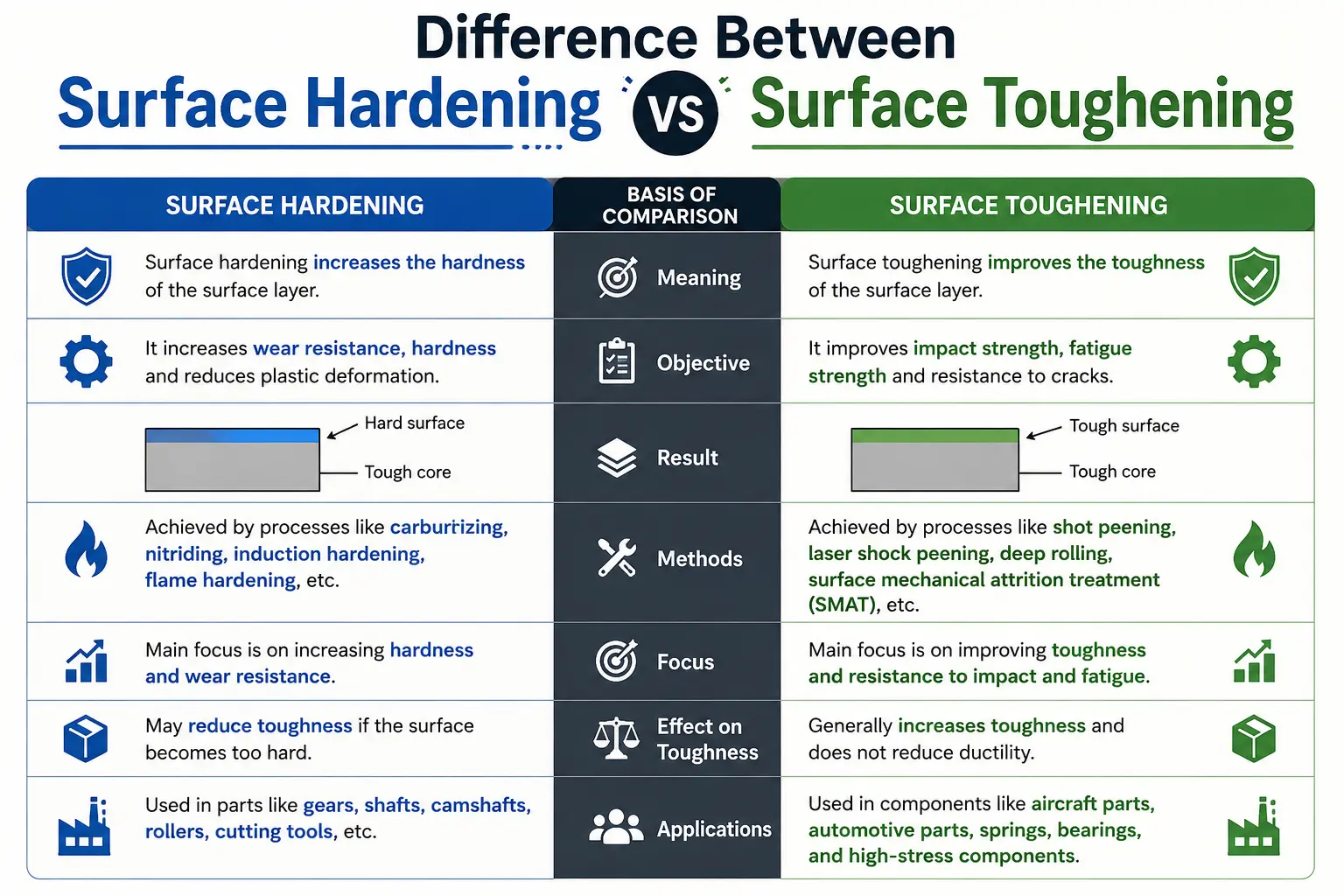
Surface hardening is a process applied to the surface of a material to improve its resistance to wear and abrasion. This process is carried out without altering the properties of the material’s core, thus preserving its ductility and toughness. Surface hardening is achieved through various methods, such as quenching, nitriding, carburizing, and flame hardening, among others. Each of these methods has its own characteristics and is chosen according to the type of material and the desired properties.
Surface hardening methods
- Tempering:This method involves heating the material to a specific temperature and then rapidly cooling it, usually in water or oil, to increase its hardness.
- Nitriding:This involves introducing nitrogen into the surface of the steel at high temperatures, which improves its hardness and wear resistance.
- Carburizing:This process involves the diffusion of carbon into the surface of the steel, increasing its surface hardness.
- Flame hardening:A flame is used to heat the surface of the material, followed by rapid cooling to harden it.
Surface hardening methods are especially useful in applications where parts are subjected to extreme wear conditions, such as gears, shafts, and cutting tools. However, it is important to note that while the surface becomes harder, the interior of the material remains softer, which can be a disadvantage in some applications requiring high strength throughout the material.
Strain hardening
On the other hand, strain hardening is a process that occurs when a material undergoes plastic deformation. Unlike surface hardening, this process affects not only the surface but the entire material. During deformation, the atoms of the material rearrange themselves, resulting in increased strength and hardness. This phenomenon is common in metals and is observed when they undergo processes such as rolling, forging, or drawing.
Characteristics of strain hardening
- Increased strength:Plastic deformation causes an increase in the strength of the material.
- Decreased ductility:As a material hardens by strain, its ability to deform without breaking decreases.
- Dependence on the type of material:Not all materials respond equally to strain hardening; some, such as ductile metals, are more susceptible to this phenomenon.
Strain hardening is fundamental in manufacturing processes, as it allows for the production of parts with improved mechanical properties. However, it also has its disadvantages. For example, if a material is subjected to excessive deformation, fracture or failure can occur. Furthermore, in some cases, subsequent heat treatment is necessary to relieve internal stresses and restore some of the lost ductility.
Key differences between surface hardening and strain hardening
The differences between surface hardening and strain hardening are significant and can be summarized in several key aspects. First, the application method differs. Surface hardening is achieved through thermal or chemical processes, while strain hardening occurs due to the mechanical manipulation of the material. This difference in method also results in a variation in the depth of hardening: surface hardening affects only the outer layer of the material, while strain hardening affects the entire volume of the material.
Other significant differences
- Properties affected:Surface hardening mainly improves wear resistance, while strain hardening increases overall strength and hardness.
- Applications:Surface hardening is used in parts that require high wear resistance, while strain hardening is common in structural components.
- Temperature:Surface hardening processes often involve significant temperature changes, whereas strain hardening is carried out at room temperature or slightly increased.
These differences are crucial when selecting the appropriate process for a specific application. For example, if high wear resistance is required in a cutting tool, surface hardening may be the best option. However, if greater structural strength is desired in a component, strain hardening might be more suitable.
Advantages and disadvantages of each process
When considering surface hardening and strain hardening, it is important to analyze both the advantages and disadvantages of each. In the case of surface hardening, one of its main advantages is that it allows for improved surface hardness without affecting the core properties, resulting in a more durable part capable of withstanding severe wear conditions. Furthermore, surface hardening processes can be relatively quick and inexpensive, making them attractive to industry.
Advantages of surface hardening
- Improved wear resistance:Increases the service life of parts under abrasive conditions.
- Preservation of ductility:Maintains the toughness of the material, preventing fractures.
- Versatility:It can be applied to a wide variety of metals and alloys.
However, there are also disadvantages. For example, surface hardening may not be sufficient for applications requiring high strength throughout the material, and in some cases, it can generate internal stresses that could lead to premature failure of the part. Furthermore, some surface hardening processes can be expensive and require precise control of the treatment conditions.
Disadvantages of surface hardening
- Depth limitation:The improved hardness only affects the surface, leaving the core softer.
- Possible internal stresses:It can generate stresses that compromise the integrity of the material.
- Cost and complexity:Some methods can be expensive and require advanced technology.
Regarding strain hardening, one of its main advantages is that it improves the overall strength and toughness of the material, which is beneficial in structural applications. This process can also be carried out under relatively simple conditions and does not require additional treatments. However, disadvantages include the potential decrease in ductility and the risk of fracture if excessive strain is applied.
Advantages of strain hardening
- General increase in strength:Improves mechanical properties throughout the material.
- Relatively simple process:It can be done with basic equipment and without additional heat treatments.
- Application in various industries:It is widely used in the manufacture of structural components and machine parts.
On the other hand, the decrease in ductility can be a significant disadvantage in applications requiring flexibility. Furthermore, if the material is subjected to excessive deformation, it can lead to failure, which can be detrimental in critical environments. Therefore, it is essential to find a balance between strength and ductility when applying this process.
Disadvantages of strain hardening
- Reduced ductility:This can make the material more brittle and prone to fracture.
- Risk of failure due to excessive deformation:May compromise the integrity of the material.
- Application limitations:Not all materials benefit from this process in the same way.
Industrial applications of each process
Both surface hardening and strain hardening processes have very specific industrial applications that take advantage of their unique characteristics. Surface hardening is commonly used on components subject to high wear. For example, in the manufacture of cutting tools, the surface must be extremely hard to resist abrasion during the machining process. Similarly, in the automotive industry, shafts and gears are often surface hardened to extend their service life.
Examples of surface hardening applications
- Cutting tools:They improve durability and efficiency in machining processes.
- Gears and shafts:They extend the useful life in transmission systems.
- Machinery parts:They increase wear resistance under severe conditions.
On the other hand, strain hardening is used in situations where materials with high structural strength are required. For example, in the manufacture of metal structures, forging and rolling are common processes that use this type of hardening to obtain strong and durable parts. It is also used in the construction industry, where beams and columns that can support heavy loads are required.
Examples of strain hardening applications
- Metal structures:These are used in buildings and bridges to support heavy loads.
- Machinery parts:Components that require high strength and durability.
- Automobiles:Axles and chassis that must be strong and lightweight.
It is evident that both processes are essential in modern engineering and manufacturing, and each has its place in the production of components that meet specific strength and durability requirements.
Final considerations on surface and strain hardening
When choosing between surface hardening and strain hardening, it is crucial to consider the desired material properties, the operating conditions, and the type of load it will be subjected to. Each process has its own advantages and disadvantages, and the right choice can make a significant difference in the efficiency and durability of the produced parts. Furthermore, it is important to remember that in some cases, combining both processes can be beneficial to obtain a material with both high surface strength and good structural strength.
Finally, research and development in the field of hardening continues to advance, and new methods and technologies are likely to emerge that further improve the effectiveness of these processes. Over time, this could lead to the creation of stronger and more durable materials, benefiting a wide range of industries and applications. Understanding the principles behind surface and strain hardening is therefore essential for engineers, designers, and manufacturers seeking to optimize their products and processes.
