

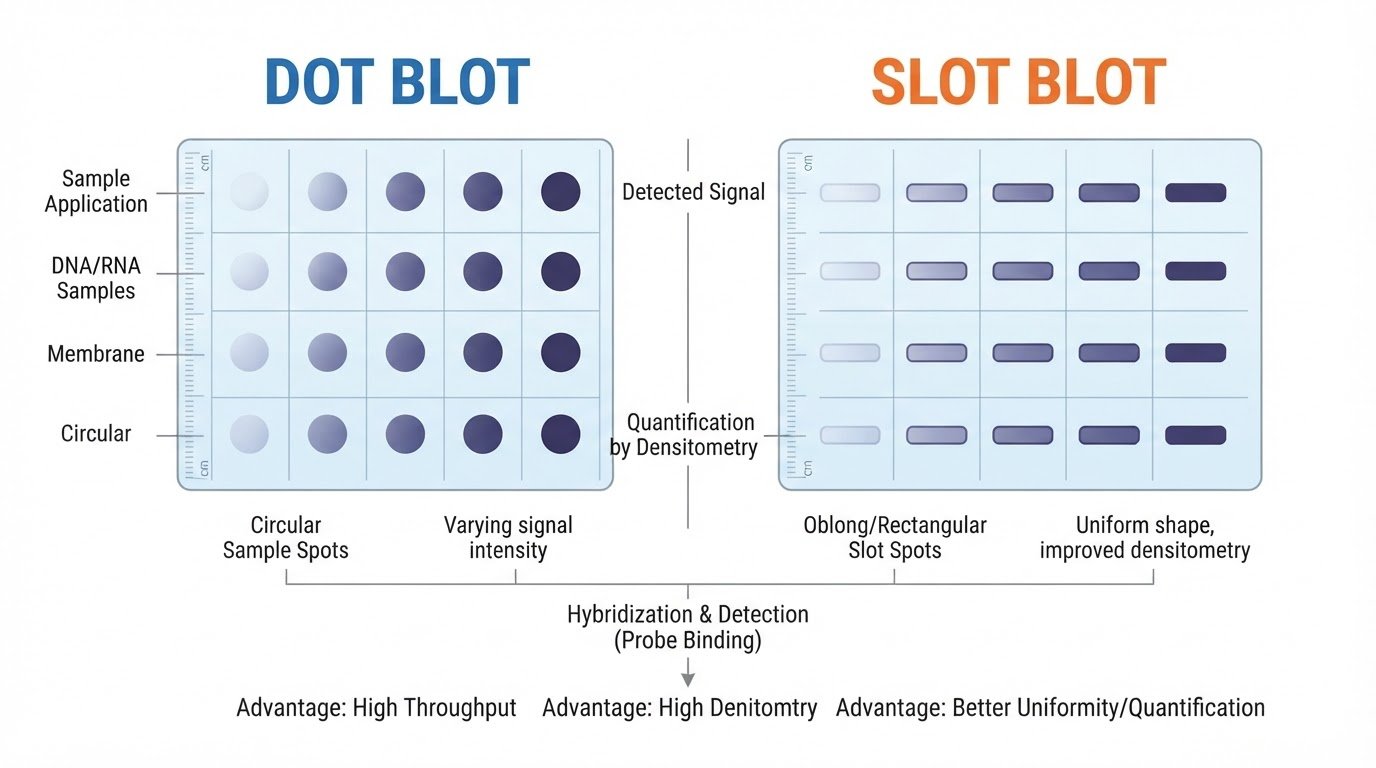
Dot blot and slot blot techniques are analytical methods used in molecular biology and biochemistry. Both techniques are used to detect and quantify the presence of biomolecules, such as proteins or nucleic acids, in a sample. However, there are significant differences between them that can influence their application and results. In this article, we will explore the differences between dot blot and slot blot, as well as their characteristics, advantages, and disadvantages, to provide a clear understanding of each method.
Basic Differences between Dot Blot and Slot Blot
One of the main differences between dot blot and slot blot lies in how the samples are applied to the membrane. In a dot blot , the samples are deposited as discrete dots on the membrane, allowing for easier visualization of each sample. In contrast, a slot blot allows the samples to be applied in a continuous line, covering a wider area of the membrane. This difference in sample application can affect the sensitivity and accuracy of the detection, depending on the nature of the sample and the analyses to be performed.
Furthermore, the way samples are processed also differs between the two methods. In Dot Blot , the dots can be spaced further apart, allowing for better visual separation of the samples. This can be useful when working with multiple samples that need to be compared. On the other hand, Slot Blot provides greater uniformity in application, which can be beneficial for quantitative studies where a precise comparison of biomolecule concentrations in the samples is required.
Dot Blot Applications
Dot blot is frequently used in research requiring the rapid and simple detection of biomolecules. This technique is ideal for preliminary studies seeking to determine the presence or absence of a specific target in different samples. For example, in infectious disease research, dot blot can be used to detect the presence of antibodies in patient serum, which can aid in initial diagnosis.
Another important application of dot blot is in protein detection. Researchers can use this technique to identify the presence of specific proteins in a complex mixture, such as a cell extract. This is achieved by using specific antibodies that bind to the target protein, allowing its visualization on the membrane. This technique is invaluable in protein-protein interaction studies and in characterizing proteins under different experimental conditions.
Slot Blot Applications
Slot blot is especially useful in studies requiring precise quantification of biomolecules. This technique is commonly used to detect nucleic acids, such as DNA or RNA, in various biological samples. By applying the samples in a continuous line, a uniform distribution is achieved, facilitating the comparison of concentrations between different samples. This is crucial in gene expression studies, where it is necessary to quantify the amount of messenger RNA present under different conditions.
Furthermore, slot blots are widely used in genotyping studies and polymorphism analysis. Researchers can use this technique to detect variations in DNA sequences, which can have implications for genetic research and the diagnosis of inherited diseases. The ability to accurately quantify the amount of DNA present in a sample is one of the reasons why slot blots are so highly valued in the field of molecular genetics.
Advantages of Dot Blot
One of the main advantages of dot blot is its simplicity. The technique is relatively easy to perform and does not require sophisticated equipment, making it accessible to many laboratories. Furthermore, dot blot allows for rapid visualization of results, which can be beneficial in situations where quick decisions need to be made based on the data obtained.
Another advantage of dot blot is its versatility. This technique can be used to detect a wide variety of biomolecules, including proteins, nucleic acids, and metabolites. This flexibility allows researchers to adapt the method to their specific needs, which is especially useful in multidisciplinary studies working with different types of samples.
Advantages of the Slot Blot
Slot blot offers significant advantages in terms of quantification. The uniform application of samples allows for a more precise comparison of concentrations, which is essential in studies requiring accurate measurement. This quantification capability makes slot blot a preferred choice in research seeking to establish correlations between the quantity of biomolecules and experimental variables.
Furthermore, the Slot Blot is ideal for analyzing multiple samples simultaneously. Its design allows for processing several samples in a single experiment, saving time and resources. This is especially useful in studies involving large amounts of data, where efficient sample handling can be critical to experimental success.
Disadvantages of the Dot Blot
Despite its advantages, the dot blot has some disadvantages that must be considered. One of the main limitations is its lower quantification capacity compared to the slot blot . The distribution of samples at discrete points can make accurate comparison of concentrations difficult, especially if the samples are very similar in quantity. This can lead to misinterpretations if proper precautions are not taken.
Another disadvantage of dot blot is its potential for reduced sensitivity in detecting biomolecules at very low concentrations. Because samples are applied in dots, sensitivity can be affected by variability in application or the quality of the reagents used. This can be problematic in research aimed at detecting biomolecules in the early stages of disease or under conditions where concentrations are minimal.
Disadvantages of the Slot Blot
The slot blot , while useful for quantification, also has disadvantages. One of the main limitations is its complexity compared to the dot blot . The need for more careful and uniform application can require more time and attention to detail, which can be a drawback in laboratories with limited resources or in situations where time is of the essence.
Furthermore, slot blots may be less effective at detecting biomolecules present in very small quantities. While the technique is excellent for samples with moderate to high concentrations, it may not be the best option for detecting rare biomolecules. This can limit its application in certain research areas where sensitivity is critical.
Final Considerations on the Choice of Techniques
When choosing between dot blotting and slot blotting , it is important to consider the objective of the experiment and the characteristics of the samples. Selecting the appropriate technique can influence the quality of the results and the interpretation of the data. For example, if the objective is to quickly and easily detect the presence of biomolecules, dot blotting might be the best option. However, if precise quantification is required, slot blotting would be more suitable.
Furthermore, it is essential to consider the experience of the laboratory staff. If the staff is more familiar with a particular technique, it may be more efficient to use that technique rather than trying to learn a new method. Training and familiarity with the equipment can also influence the quality of the results obtained.
Examples of Use in Research
In the field of molecular biology, both dot blot and slot blot have been used in a variety of research studies. For example, in the study of autoimmune diseases, dot blot has been used to detect specific antibodies in serum, which can help physicians diagnose conditions such as lupus or rheumatoid arthritis. The simplicity of this technique allows for rapid testing in a clinical setting.
On the other hand, slot blot analysis has been widely used in gene expression studies. Researchers have used this technique to quantify gene expression under different experimental conditions, such as in response to drug treatments or in developmental studies. The ability to accurately quantify messenger RNA has provided valuable information about the underlying molecular mechanisms in various diseases.
Conclusion of the Comparison
Both dot blotting and slot blotting are valuable techniques in molecular biology and biochemistry. Each method has its own advantages and disadvantages, and the choice between them depends on the specific research needs. It is important for researchers to carefully consider the characteristics of their samples and the objectives of their studies when deciding which technique to use. With a clear understanding of the differences and applications of each method, scientists can make informed decisions that maximize the quality and utility of their experimental results.
