

What is alternative RNA splicing?
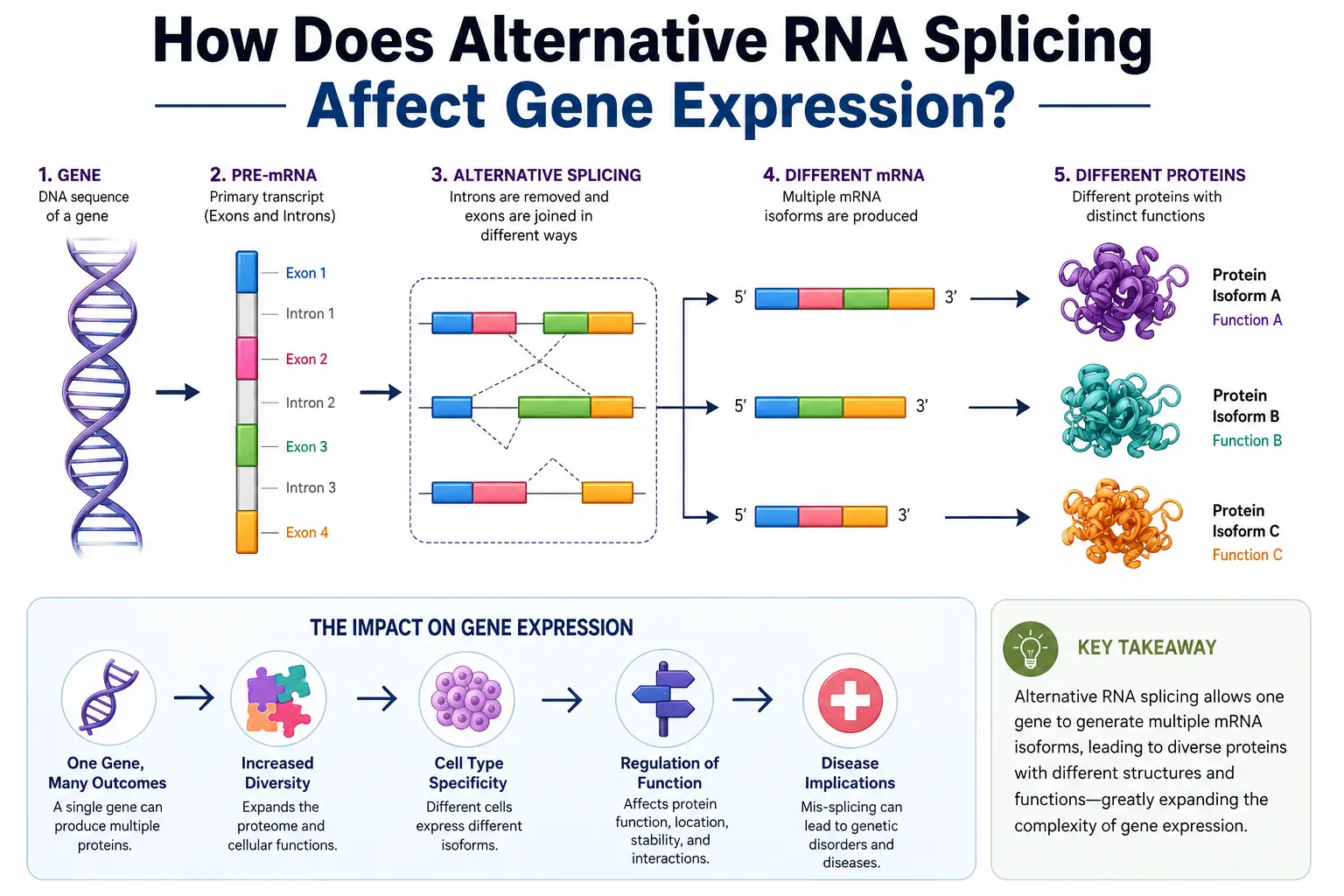
Alternative RNA splicing is a fundamental biological process that allows cells to generate multiple forms of proteins from a single gene. Simply put, after DNA is transcribed into messenger RNA (mRNA), this RNA can be processed in different ways. This process includes the removal of introns (non-coding sequences) and the joining of exons (coding sequences) in various ways. Thus, a single gene can give rise to several distinct proteins, each with specific functions. This is crucial for functional diversity in cells, as it allows a limited number of genes to produce a variety of protein products.
Alternative splicing occurs primarily in eukaryotes, organisms whose cells have defined nuclei. In these organisms, the alternative splicing process can be influenced by various factors, such as environmental conditions, tissue type, and cellular signals. This means that the same gene can be spliced in different ways in different cell types or in response to different stimuli. This ability to change how messenger RNAs are spliced is one of the reasons why organisms are so adaptable and diverse.
Importance of alternative splicing in gene expression
Gene expression refers to how genes are used to produce proteins in a cell. Alternative splicing plays a crucial role in this process, as it allows a single gene to be expressed in multiple ways. This is especially important in multicellular organisms, where different cell types require different proteins to perform specific functions. For example, liver cells and nerve cells may use the same gene, but through alternative splicing, they can produce proteins that are very different in structure and function.
Furthermore, alternative splicing contributes to the regulation of gene expression. This means that, instead of relying solely on the amount of a gene that is expressed, cells can adjust how messenger RNAs are spliced to respond to different conditions. This provides an additional form of control over protein production, which is essential for the organism’s development and homeostasis. Therefore, alternative splicing not only increases protein diversity but also allows cells to adapt to their environment.
Alternative splicing mechanisms
The alternative splicing process is complex and involves several molecular components. First, there are proteins called splicing factors that bind to specific RNA sequences and help determine how the splicing will occur. These proteins can influence the choice of exons and the removal of introns, leading to different combinations of messenger RNA. The interaction between these splicing factors and the RNA is critical to the final outcome of the process.
In addition, there are signals in the RNA that tell the splicing proteins where to bind. These signals are crucial to ensuring accurate splicing. However, errors can sometimes occur in this process, leading to the production of defective proteins. These errors can be caused by mutations in the DNA or by problems with the splicing machinery. When this happens, it can have serious consequences for the cell and, in some cases, lead to disease.
Alternative splice types
- Alternative exon splicing: In this type, some exons are included or excluded from the final messenger RNA.
- Alternative splicing of start or stop sites: a different site is chosen to start or stop splicing, which can result in proteins of different lengths.
- Multiple exon splicing: where several exons can be excluded or included at once, further increasing protein diversity.
These types of alternative splicing allow for great flexibility in protein production. Depending on the cell’s needs, different combinations of exons can be used, resulting in proteins that can have entirely different functions. This ability to generate variability from a single gene is one of the most fascinating aspects of molecular biology and is fundamental to understanding how organisms function.
Factors that influence alternative splicing
Alternative splicing does not occur randomly; several factors can influence how it takes place. One of the main factors is the regulatory signals present in messenger RNA. These signals can be specific nucleotide sequences that act as markers for splicing proteins. The presence or absence of these signals can determine whether an exon will be included or excluded in the final RNA.
Another important factor is cellular conditions. For example, in response to environmental stress, such as nutrient deprivation or exposure to toxins, cells can modify their alternative splicing pattern to produce proteins that help them survive. This is especially evident in developing cells, where alternative splicing can be crucial for tissue and organ formation. Thus, alternative splicing is not only a mechanism of variability but also a tool for adaptation.
Examples of factors that affect alternative splicing
- Transcription factors: proteins that bind to DNA and regulate gene expression, can influence alternative splicing.
- Post-translational modifications: changes in proteins after their synthesis that can affect their function and their interaction with RNA.
- MicroRNAs: small RNA molecules that can regulate the stability of messenger RNA and, therefore, alternative splicing.
These factors can act together or individually, adding another layer of complexity to the alternative splicing process. Therefore, studying these factors is important not only for understanding how alternative splicing occurs, but also for understanding how gene expression is regulated in general.
Alternative splicing and diseases
Alternative splicing has significant implications for health and disease. Errors in the splicing process can lead to the production of defective proteins that may contribute to the development of various diseases. For example, certain forms of cancer have been associated with alterations in the alternative splicing of genes that regulate cell growth. In these cases, alternative splicing can result in the production of proteins that promote uncontrolled cell proliferation.
Furthermore, genetic diseases such as muscular dystrophy and some neurodegenerative disorders have also been linked to failures in alternative splicing. For example, in Duchenne muscular dystrophy, alternative splicing has been observed to lead to the production of truncated forms of the dystrophin protein, resulting in impaired muscle function. These examples underscore the importance of alternative splicing not only in normal biology but also in pathology.
Diseases associated with alternative splicing
- Cancer: alterations in the splicing of oncogenes and tumor suppressor genes.
- Muscular dystrophies: mutations that affect the splicing of essential muscle proteins.
- Neurodegenerative disorders: such as amyotrophic lateral sclerosis, where the alternative splicing of certain genes is altered.
Research into how alternative splicing relates to these diseases is an active area of study. Understanding these mechanisms can help develop new therapies and treatments that address the underlying causes of these conditions. Furthermore, identifying biomarkers based on alternative splicing patterns could improve the diagnosis and prognosis of various diseases.
Future perspectives in alternative splicing research
As technology advances, research on alternative splicing is constantly evolving. Next-generation sequencing techniques have allowed scientists to analyze alternative splicing at a much more detailed level. This has led to a better understanding of how it is regulated and how it is associated with various diseases. As more data is collected, new patterns and mechanisms that were not previously apparent are likely to be discovered.
Furthermore, research in this field is also opening new opportunities for the development of therapies. For example, manipulating alternative splicing could be a viable strategy for treating genetic diseases. Some therapies under development aim to correct defective alternative splicing, thereby restoring the production of functional proteins. This approach could offer new hope for those suffering from diseases caused by errors in alternative splicing.
Promising areas of research
- Development of therapies based on alternative splicing: strategies to correct or modify splicing in genetic diseases.
- Study of alternative splice dynamics: understanding how and when splice changes occur in response to different stimuli.
- Biomarker research: identifying alternative splicing patterns that may serve as indicators of disease.
Future research into alternative splicing promises not only to increase our understanding of fundamental biology but also to have a direct impact on medicine and disease treatment. As more secrets of this process are revealed, new avenues for improving human health and well-being will open up.
Conclusions on the alternative splice
Alternative RNA splicing is an essential process that allows cells to create a diversity of proteins from a limited number of genes. This mechanism not only contributes to functional diversity in organisms but also plays a crucial role in regulating gene expression. Through different types of alternative splicing and the influence of various factors, cells can adapt to different conditions and functional requirements.
Research on alternative splicing has also revealed its importance in the context of various diseases, where errors in this process can lead to the production of defective proteins. With the advancement of research technologies, our understanding of alternative splicing is expected to continue growing, opening new opportunities for therapeutic intervention and the improvement of human health. As we explore this fascinating field, it is becoming clear that alternative RNA splicing is a key area in modern biology and medicine.
