

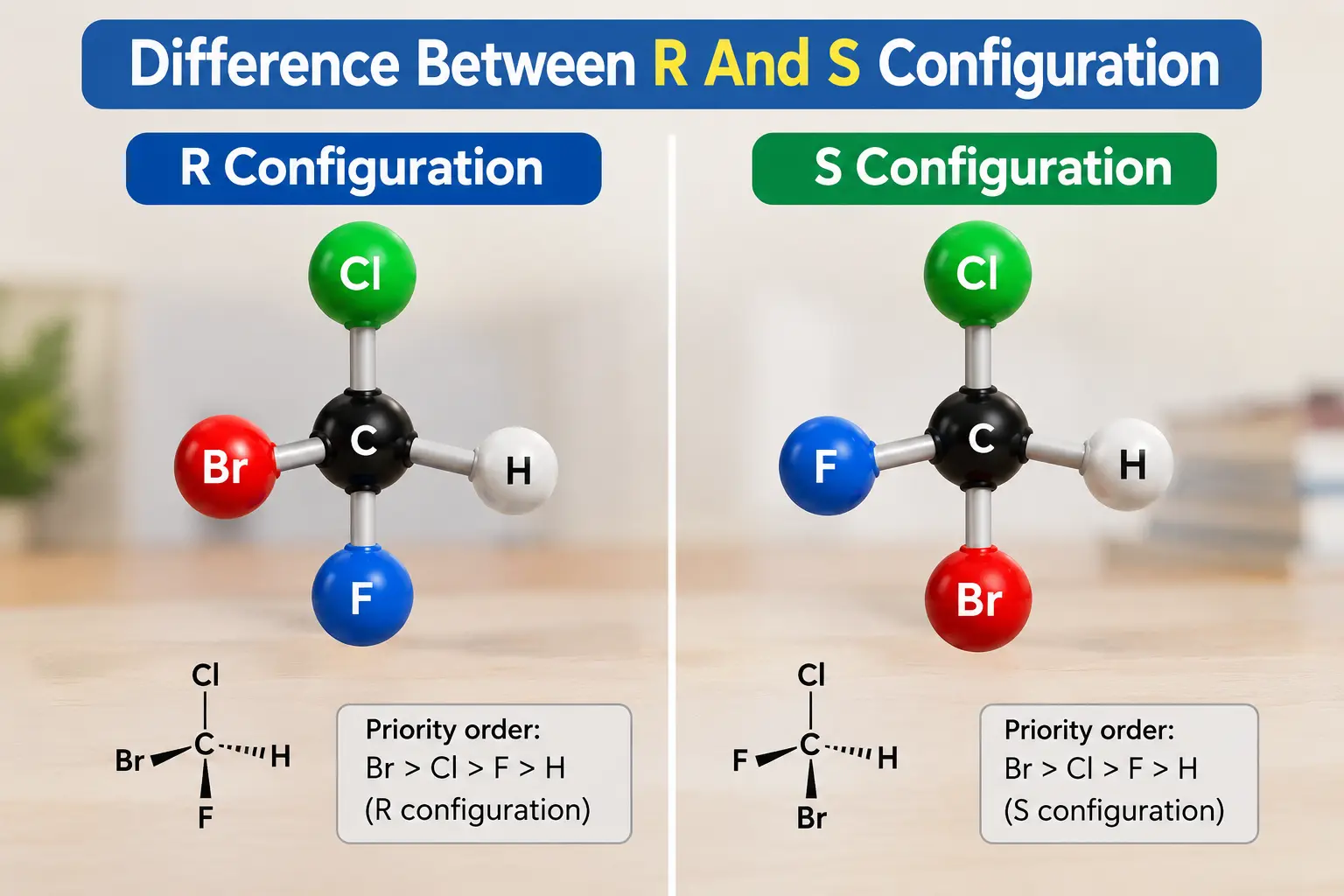
The R configuration and S configuration are terms primarily used in organic chemistry to describe the arrangement of atoms in a molecule containing a chiral center. These configurations are essential for understanding stereoisomerism , which is how molecules can have the same molecular formula but different spatial arrangements. This difference in arrangement can significantly affect the physical and chemical properties of substances, making an understanding of these configurations crucial in various applications, from pharmacology to biology. In this article, we will explore in depth the differences between the R and S configurations, their implications, and how they are determined.
Definition of R and S configuration
The R and S configurations refer to how groups are arranged around a chiral carbon atom. A chiral carbon atom is one that is bonded to four different groups. To determine whether a configuration is R or S, the Cahn-Ingold-Prelog nomenclature system is used. This system assigns priorities to groups based on the atomic number of the atoms directly bonded to the chiral carbon. Groups with higher atomic numbers receive higher priority. For example, carbon (C) has an atomic number of 6, while oxygen (O) has an atomic number of 8, meaning that oxygen will have higher priority than carbon.
Once priorities have been assigned, the arrangement of the groups relative to the chiral carbon is considered. If the highest priority groups are arranged clockwise, the configuration is designated R (from the Latin “rectus,” meaning straight). Conversely, if the highest priority groups are arranged counterclockwise, the configuration is designated S (from the Latin “sinister,” meaning left). This method provides a systematic approach to naming the stereoisomeric configurations of molecules.
Importance of the R and S configuration in chemistry
The difference between R and S configurations is not merely academic; it has significant practical consequences in various areas of chemistry. For example, in pharmacology , compounds with R and S configurations can have very different biological effects. A drug with an R configuration may be effective in treating a disease, while its S isomer may be ineffective or even harmful. This is because the molecules can interact differently with biological receptors in the human body, leading to variations in drug efficacy and safety.
Furthermore, the R and S configurations are fundamental in organic synthesis , where chemists seek to create specific compounds with desired properties. By understanding how to manipulate these configurations, scientists can design molecules that behave in the way they want. For example, in the creation of new drugs, the ability to control the stereoisomeric configuration can lead to the production of safer and more effective medications.
Examples of molecules with R and S configurations
A classic example of the difference between R and S configurations is lactic acid. Lactic acid has a chiral carbon and can exist in two forms: R and S. The R form of lactic acid is the one found in the human body during intense exercise, while the S form is less common. This type of configuration difference can have a significant impact on how the body metabolizes these compounds. In fact, lactic acid is produced in the body as a result of fermentation, and its configuration can influence the energy obtained from this process.
Another example is limonene , a compound found in citrus peels. Limonene has two isomers: R-limonene, which smells like oranges, and S-limonene, which smells like lemons. This difference in configuration not only affects the aroma but can also influence how these compounds interact with other chemicals in cleaning products and fragrances. Therefore, the R and S configurations affect not only the chemistry of the molecules but also their applications in everyday life.
Determination of the R and S configuration
Determining whether a compound has an R or S configuration is done through a systematic process. First, the chiral carbon atom in the molecule is identified. Then, priorities are assigned to the groups attached to this carbon using the Cahn-Ingold-Prelog system. It is important to remember that the chiral carbon must be viewed from the side opposite the lowest priority group to make the correct determination. This approach is crucial to avoid errors in assigning configurations.
Once the priorities have been assigned, the next step is to observe the arrangement of the highest priority groups. If, following the priority order, the groups are arranged clockwise, the configuration is R. If they are arranged counterclockwise, the configuration is S. This method provides a clear and precise way to classify stereoisomeric configurations and is widely used in chemistry laboratories and the pharmaceutical industry.
Practical applications of the R and S configuration
The practical applications of the R and S configurations are broad and varied. In the field of medicine , the ability to differentiate between R and S isomers is crucial for drug development. For example, in drug production, the isomer that is most effective and safe for treating a specific disease is often sought. Research into how different configurations affect a drug’s interaction with its biological target has led to the creation of more targeted and effective medications.
Furthermore, understanding R and S configurations is also important in the food industry . For example, some compounds used as food additives can have different properties depending on their stereoisomeric configuration. This can affect not only the taste and aroma of food, but also its stability and safety. Therefore, the food industry must pay attention to these differences to ensure that products are safe and of high quality.
Challenges in understanding the R and S configuration
Despite the clarity offered by the Cahn-Ingold-Prelog nomenclature system, challenges remain in understanding and applying R and S configurations. One of the main challenges is identifying chiral carbons in more complex molecules. As molecules become larger and more complex, determining the configuration can become more complicated. This is especially true in compounds containing multiple chiral centers, where all possible configurations must be considered.
Another challenge is the graphical representation of R and S configurations. Although chemists can use three-dimensional models to visualize molecules, the two-dimensional representation of chemical structures can be confusing. This can lead to errors in assigning configurations, which can have significant consequences for the research and development of new compounds. Therefore, it is important that chemistry students and professionals are well-trained in interpreting these representations and determining configurations.
Future research on R and S configurations
Research in the field of R and S configurations continues to evolve, and there are many areas where advances are expected. One of the most promising areas is the synthesis of drugs using more efficient methods that allow for the selective production of a single isomer rather than a mixture of isomers. This would not only save time and resources but also improve the safety and efficacy of medications. New synthesis techniques are being developed that allow scientists to create molecules with specific configurations more easily and quickly.
Furthermore, research into how R and S configurations affect molecular interactions in biological systems is also on the rise. Understanding how differences in configuration can influence biochemical reactions may open new avenues for treating diseases and developing more effective therapies. Exploring stereoisomerism in biological systems could lead to significant discoveries in medicine and biology, which in turn could have a positive impact on human health.
Conclusions on the R and S configuration
The difference between R and S configurations is a fundamental concept in chemistry with broad implications for research and practical application. From pharmacology to the food industry, understanding these configurations is crucial for developing new compounds and improving existing ones. As research progresses, we are likely to continue discovering new ways in which these configurations affect our lives and the world around us.
