

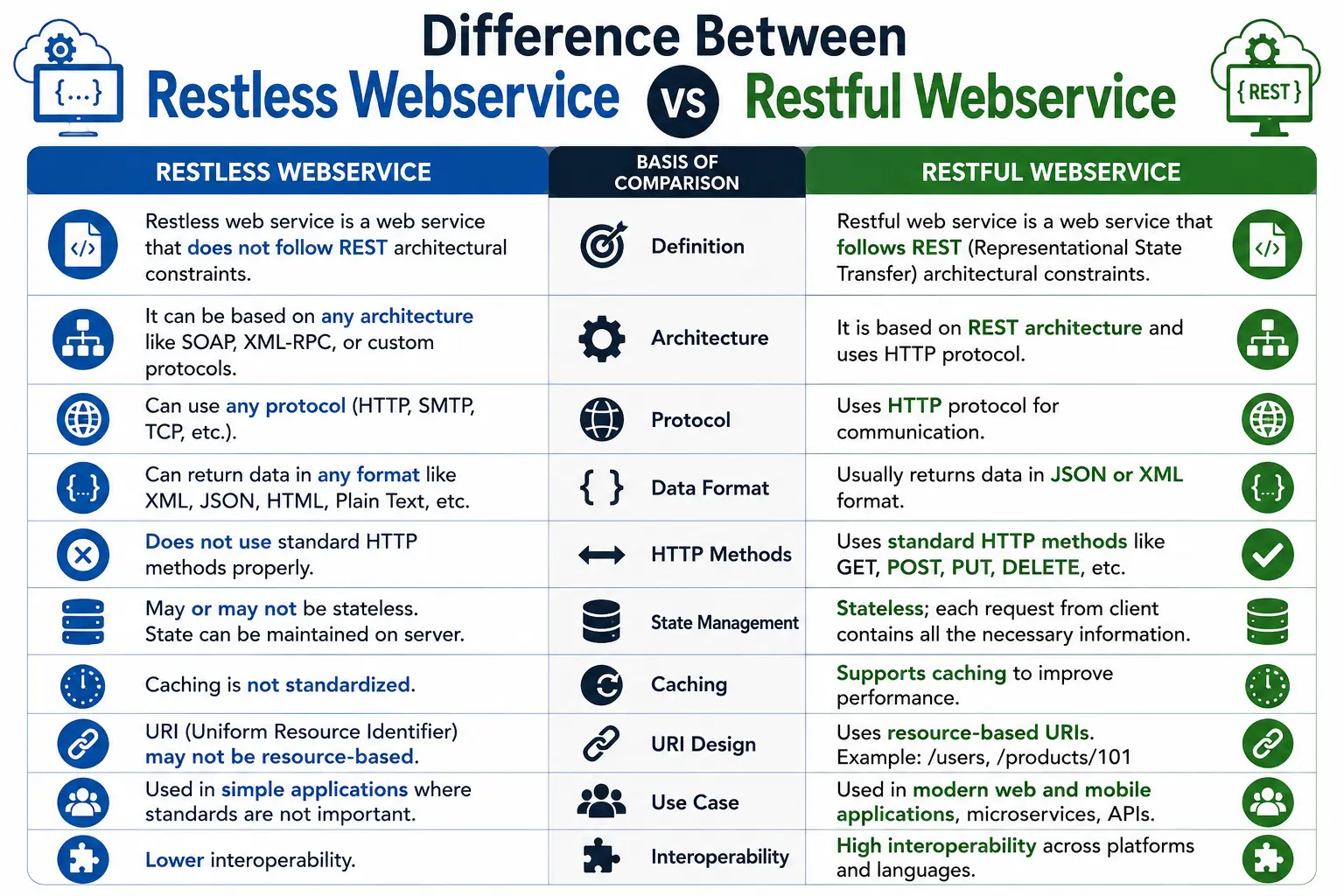
In the world of technology, especially in software development, understanding the different architectures and communication styles used is fundamental. Two terms that are frequently encountered are Restful and Restless. Although both relate to how applications communicate with each other, there are significant differences that are important to know. In this article, we will explore these differences in depth, as well as their implications and applications in webservice development.
What is a Restful webservice?
A Restful webservice is based on the Representational State Transfer (REST) principle, an architectural style for network design. REST was introduced by Roy Fielding in his doctoral dissertation in 2000. This style focuses on the use of HTTP methods and relies on the exchange of resources through URLs. Restful webservices use standard methods such as GET, POST, PUT, and DELETE to interact with resources.
One of the most important characteristics of a Restful webservice is that it is stateless . This means that each client request to the server must contain all the information necessary to understand and process the request. No information about the client’s state is stored on the server, allowing for greater scalability and flexibility in the system architecture.
Characteristics of a Restful webservice
- HTTP usage:Uses standard HTTP methods to perform operations on resources.
- Identifiable resources:Each resource has a unique URI that identifies it.
- Resource representations:Resources can be represented in different formats, such as JSON or XML.
- Stateless:Each request is independent and does not depend on the server’s state.
Furthermore, Restful webservices are scalable, meaning they can handle a large number of requests simultaneously. This is crucial in modern applications where demand can fluctuate significantly. They also support caching , meaning responses can be cached to improve performance and reduce the load on the server.
What is a Restless webservice?
On the other hand, a Restless webservice is one that does not follow the conventions and principles of REST. Although it may use HTTP for communication, it does not respect state constraints or consistently use standard methods. This means there may be inconsistencies in how requests and responses are handled.
Restless webservices are often used in situations where greater flexibility is needed or where the limitations of REST don’t suit the project’s requirements. However, this flexibility can come at the expense of scalability and interoperability, as they don’t follow a defined set of rules that facilitate communication between different systems.
Characteristics of a Restless webservice
- Inconsistent use of HTTP:You may use HTTP methods in a non-standard way or not follow REST conventions.
- State dependency:You can store information about the client’s state on the server.
- Lack of uniformity:The way resources are handled can vary between different services.
- Less scalable:May have difficulty handling a high volume of requests.
A Restless webservice may be more suitable for applications that require a high degree of customization or that need to interact with legacy systems that are not REST-compatible. However, this customization can complicate maintenance and integration with other services.
Comparison between Restful and Restless
Comparing Restful and Restless webservices is essential to understanding which is the best option for a given project. In terms of architecture, Restful services are designed to be more predictable and easier to understand, while Restless services can offer greater flexibility, but often at the expense of clarity and standardization.
In terms of scalability , Restful services tend to be more scalable due to their stateless nature. This means they can handle a higher volume of requests without performance being affected. On the other hand, Restless services, being state-dependent, can experience declining performance as the server load increases.
Advantages and disadvantages
- Advantages of Restful:
- Scalability and performance.
- Use of widely accepted standards.
- Ease of maintenance and understanding.
- Disadvantages of Restful:
- It may be too restrictive for certain types of applications.
- Implementation may require a significant initial effort.
- Advantages of Restless:
- Greater flexibility in implementation.
- Ability to adapt to legacy systems.
- Disadvantages of Restless:
- Lower scalability and performance.
- Lack of standardization, which can complicate integration.
Practical applications of Restful and Restless
Restful webservice applications are very common in modern application development. Many API services we use today, such as those for social networks, payment platforms, and data services, are designed using Restful principles. This allows different applications to communicate effectively and efficiently, facilitating interoperability and data sharing.
On the other hand, Restless webservices may be more common in situations where significant customization is required or in environments where existing systems cannot be modified to comply with REST standards. This can include enterprise applications that need to communicate with legacy systems or applications that require complex business logic that is not well-suited to the REST framework.
Examples of use
- Restful:
- Twitter API: Allows developers to access tweets and user data through a Restful structure.
- GitHub API: Facilitates interaction with code repositories using Restful principles.
- Restless:
- Enterprise applications: Systems that require specific business logic that cannot be encapsulated in a REST model.
- Legacy systems: Interaction with older databases or applications that do not comply with REST standards.
Considerations when choosing between Restful and Restless
When deciding between a Restful and a Restless webservice, it’s important to consider several factors. One of the most important is the nature of the application . If it’s an application that will benefit from scalability and interoperability, a Restful approach is probably the best option. However, if the application requires extensive customization or needs to interact with existing systems that are not Restful, a Restless approach may be more appropriate.
Another factor to consider is ease of maintenance. Restful services, by following clear standards, tend to be easier to maintain and understand. This is especially important in collaborative development environments where multiple developers may be working on the same code. On the other hand, Restless services can be more difficult to understand and maintain due to their lack of standardization.
Costs and resources
- Restful:
- It requires an initial investment of time and resources to establish a solid architecture.
- It facilitates collaboration and long-term development.
- Restless:
- They can be faster to implement in specific situations.
- However, they can result in higher costs in the long run due to a lack of standardization and maintenance.
Conclusions on Restful and Restless
The choice between a Restful and a Restless webservice depends on the specific needs of the project. While Restful offers a robust and scalable structure, Restless can provide the flexibility required in certain situations. By understanding the differences and similarities between these two approaches, developers can make more informed decisions that benefit their projects and the applications they develop.
With the rise of mobile applications and the growing need for services that integrate effectively, understanding these concepts is becoming increasingly relevant. Therefore, it’s crucial for any developer or technology team to be aware of the differences between Restful and Restless, and how these can impact the quality and efficiency of their applications.
