

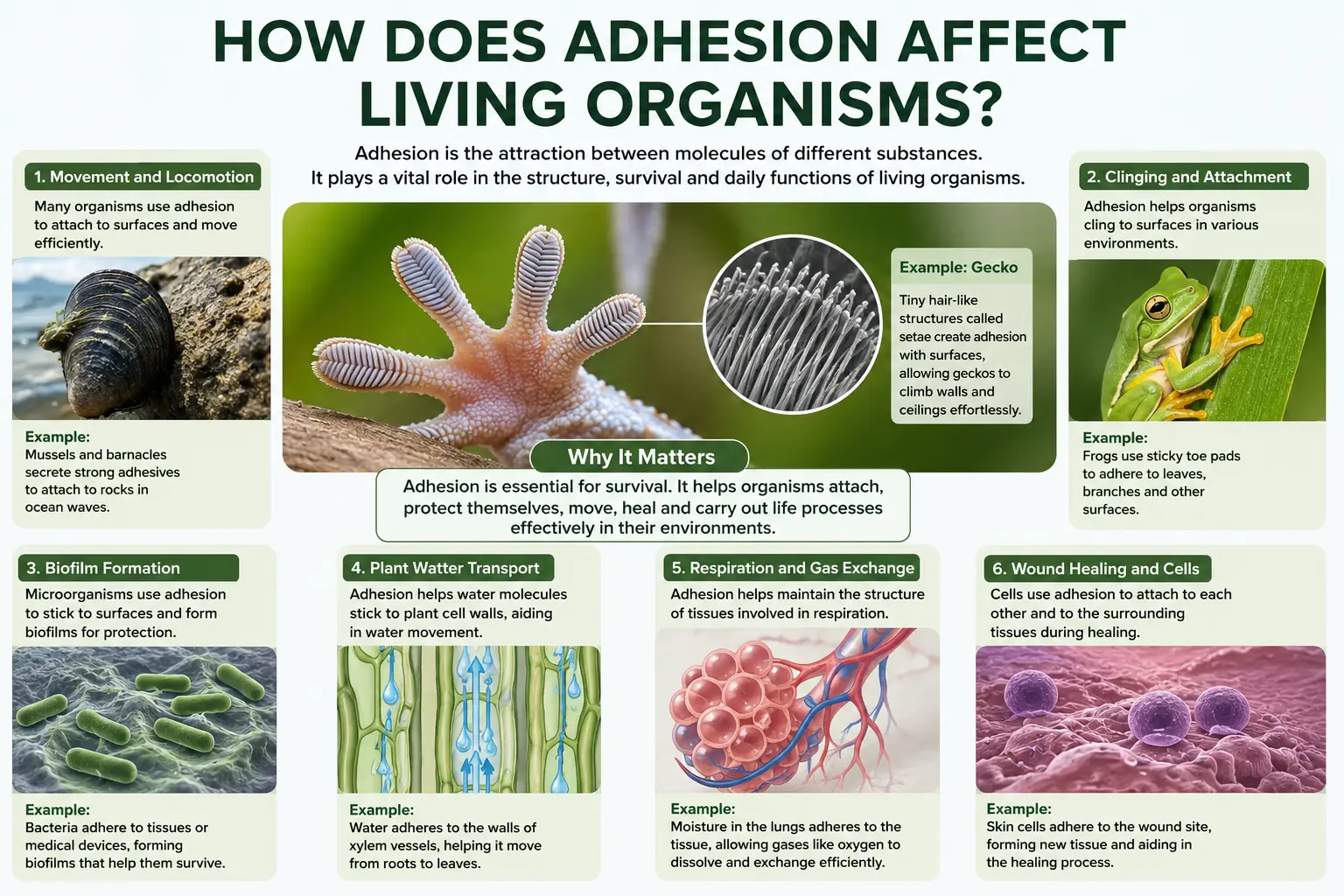
Adhesion is a naturally occurring phenomenon with a significant impact on living organisms. This process refers to the ability of cells and organisms to bind or adhere to surfaces, whether biological or inorganic. Adhesion is fundamental to various biological functions, such as tissue formation, wound healing, and the colonization of microorganisms in specific environments. In this article, we will explore how adhesion affects living organisms, analyzing its mechanisms, functions, and consequences in different contexts.
What is adhesion?
Adhesion is a physicochemical process that allows two surfaces to remain joined. In a biological context, it refers to the interaction between cells and their environment. This phenomenon can be influenced by various factors, such as the molecular structure, humidity, and electrical properties of the surfaces involved. Cells have specialized structures, such as fimbriae and pseudopods, that enable them to adhere to other cells or surfaces. Adhesion is crucial for the survival and proper functioning of organisms.
Adhesion mechanisms can be classified into two main types: mechanical adhesion and chemical adhesion. Mechanical adhesion relies on the shape and texture of surfaces, while chemical adhesion involves interactions at the molecular level, such as ionic or covalent bonds. Both types of adhesion are important for the health and development of organisms, as they enable cell communication and the formation of complex structures.
Adhesion mechanisms in unicellular organisms
Single-celled organisms, such as bacteria, rely heavily on adhesion to colonize new environments and obtain nutrients. Bacteria use specialized structures, such as fimbriae and pili, to adhere to surfaces. These structures allow bacteria to attach to host cells or inanimate surfaces, facilitating the formation of biofilms. Biofilms are communities of microorganisms that cluster and adhere to surfaces, creating a barrier that protects cells from the surrounding environment.
Biofilm formation is a crucial process in nature, as it allows bacteria to survive in adverse conditions. For example, in aquatic environments, bacteria can form biofilms on rock surfaces or inside pipes. This process not only provides them with protection but also allows them to access nutrients and form symbiotic relationships with other microorganisms. Adhesion in unicellular organisms is therefore a fundamental mechanism for their survival and adaptation.
Adhesion in multicellular organisms
In multicellular organisms, adhesion is equally important, but it occurs in a more complex manner. Cells in these organisms are organized into tissues and organs, and adhesion between them is essential for maintaining the structure and function of these systems. Cells use cell adhesion molecules (CAMs) to bind to one another. These molecules facilitate communication and recognition between cells, which is vital for the organism’s development and homeostasis.
There are different types of adhesion molecules, such as cadherins, which are important for cell adhesion in epithelial tissues, and integrins, which allow cells to adhere to the extracellular matrix. The function of these molecules is crucial in processes like embryogenesis, where cells must migrate and organize themselves to form a complete organism. Without proper adhesion, tissues could not form correctly, which could lead to malformations or diseases.
The role of adhesion in wound healing
Wound healing is a multi-stage process, and adhesion plays a crucial role in each stage. When a wound occurs, cells from the damaged tissue must migrate to the affected area and adhere to surrounding cells to repair the damage. This process begins with the formation of a blood clot, which acts as a temporary scaffold. Immune system cells and stem cells then migrate to the wound, where they must adhere to initiate tissue repair.
During wound healing, epithelial cells must proliferate and migrate to cover the wound. Adhesion is crucial at this stage, as cells must bind to the extracellular matrix and other cells to form a protective barrier. Furthermore, adhesion molecules also participate in cell-to-cell communication, facilitating the release of growth factors that promote tissue regeneration. Without adequate adhesion, the healing process can be compromised, potentially resulting in abnormal scarring or chronic wounds.
Adhesion and diseases
Adhesion is also linked to various diseases. For example, in the case of infections, pathogenic bacteria use their adhesion mechanisms to colonize host tissues. Fimbriae and pili allow them to adhere to epithelial cells of the respiratory, gastrointestinal, and urogenital tracts, facilitating infection. Once bacteria adhere, they can evade the immune system and proliferate, which can lead to serious illnesses.
Furthermore, cell adhesion also plays a significant role in the context of autoimmune diseases. In these conditions, the immune system mistakenly attacks the body’s own cells. Adhesion molecules may be involved in activating immune cells that attack healthy tissues. This can result in chronic inflammation and organ damage, impacting patients’ quality of life. Therefore, understanding adhesion mechanisms is crucial for developing therapies that can address these diseases.
Factors that affect adherence
Several factors can influence cell adhesion to surfaces. These include the physical and chemical properties of the surfaces, the composition of the medium, and the characteristics of the cells themselves. For example, rough surfaces tend to promote adhesion because they provide more contact area. Similarly, the presence of proteins or sugars on the surface can facilitate or inhibit adhesion, depending on the interactions that occur at the molecular level.
Temperature and humidity are also key factors. In high humidity, cells can adhere more easily to surfaces due to the formation of a water film that acts as a bonding medium. On the other hand, extreme temperatures can affect the stability of adhesion molecules, potentially weakening the ability of cells to bond to each other or to surfaces. These factors are essential for understanding how to optimize adhesion in various applications, from medicine to biotechnology.
Applications of adhesion in biotechnology
Adhesion has numerous applications in the field of biotechnology. For example, in tissue engineering, the goal is to promote cell adhesion to develop artificial organs. Cells must adhere properly to a scaffold that simulates the extracellular matrix to form functional tissues. To achieve this, materials are designed to promote cell adhesion, using special coatings or incorporating adhesion molecules on their surface.
Furthermore, in the production of vaccines and medications, adhesion is crucial to ensure that the active compounds remain at the desired site and are effectively absorbed by the body. Drug formulations may include agents that enhance the adhesion of particles to immune system cells, thereby increasing the efficacy of the therapy. Thus, understanding adhesion mechanisms is fundamental for the development of new technologies and treatments in the healthcare field.
Current research on adhesion
Research on cell adhesion is constantly evolving, and scientists are discovering new aspects of this phenomenon that could have a major impact on medicine and biotechnology. Currently, studies are underway to better understand how cells adhere to different surfaces and how these interactions can be manipulated for therapeutic purposes. For example, methods are being explored to inhibit the adhesion of pathogenic bacteria to medical devices, which could reduce the risk of hospital-acquired infections.
Furthermore, research is underway on the role of adhesion in cancer metastasis. Cancer cells have been found to use adhesion mechanisms to detach from the primary tumor and establish new colonies in other organs. Understanding these mechanisms could open new avenues for developing treatments that prevent cancer from spreading. Thus, research in the field of adhesion has the potential to revolutionize our understanding of various diseases and improve treatment strategies.
Conclusions on adhesion in living organisms
Adhesion is an essential phenomenon affecting all living organisms, from the simplest to the most complex. This process is not only crucial for the survival and development of organisms but also has significant implications for health and disease.
As research progresses, new applications and treatments are expected to be discovered that harness adhesion mechanisms to improve people’s quality of life. Adhesion, in its complexity and variety, remains a fascinating area of study in the field of science.
