

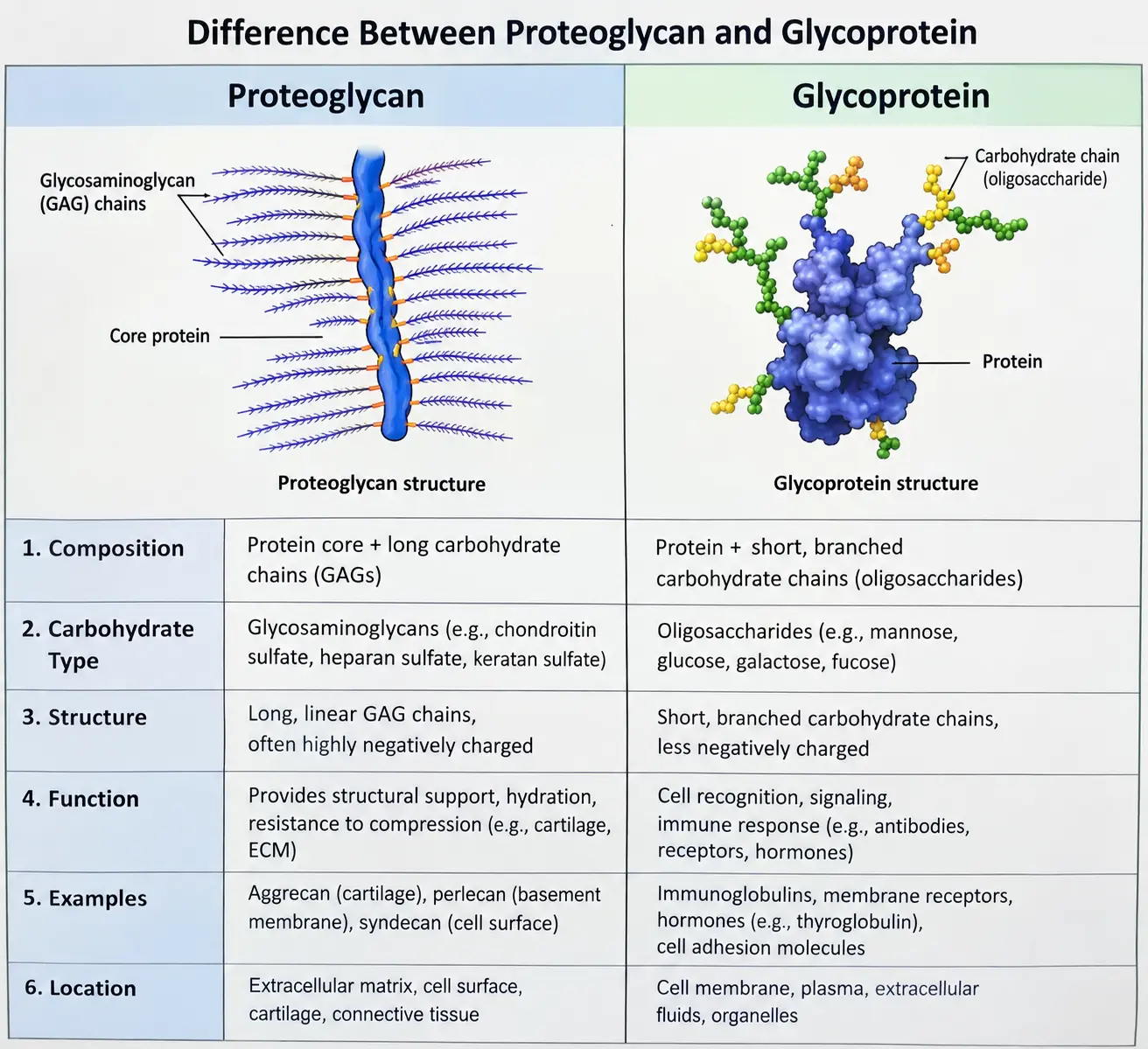
In the world of cell biology, there are various types of molecules that play crucial roles in the structure and function of organisms. Among these molecules, proteoglycans and glycoproteins are two important types that are often confused due to their similar names and functions in the body. However, they have distinct characteristics and roles that are essential for understanding how organisms function at the cellular level. This article will focus on the differences between proteoglycans and glycoproteins, exploring their structures, functions, and specific examples.
What are Proteoglycans?
Proteoglycans are macromolecules composed of a core protein linked to one or more glycosaminoglycans (GAGs). These GAGs are long chains of carbohydrates that are high in sulfate and highly hydrated, allowing them to form gels that occupy space in tissue. The combination of the protein and the GAGs gives proteoglycans unique properties, such as the ability to retain water and provide compressive strength in tissues like cartilage.
One of the most important characteristics of proteoglycans is their ability to interact with other molecules in the cellular environment. This is because GAGs have negative charges that allow them to attract cations and water, forming a gel that can cushion impacts and facilitate nutrient transport. Proteoglycans are fundamental to the extracellular matrix, where they help maintain tissue structure and function.
What are Glycoproteins?
Glycoproteins are molecules consisting of a protein linked to one or more oligosaccharides (short chains of sugars). Unlike proteoglycans, where the GAGs are long chains, the oligosaccharides in glycoproteins are shorter and can be classified into two main types: N-glycosylated glycoproteins and O-glycosylated glycoproteins. These modifications are essential for glycoprotein function, as they influence their stability, cell recognition, and biological activity.
Glycoproteins have a wide variety of functions in the body. For example, they are key components of cell membranes, where they act as receptors and signaling molecules. They are also found in body fluids such as blood, where they may play roles in coagulation and the immune response. Glycosylation, the process of adding sugars to proteins, is a critical step in glycoprotein formation and can affect their function and location within the cell.
Structural Differences Between Proteoglycans and Glycoproteins
The main structural difference between proteoglycans and glycoproteins lies in the nature of the carbohydrates attached to the proteins. In proteoglycans, glycosaminoglycans are long, repeating chains of disaccharides that bind to the core protein. These GAGs are highly hydrated and contribute to tissue viscosity and elasticity. In contrast, glycoproteins have shorter oligosaccharides that can vary in structure and composition, allowing for greater diversity in function and location.
Another important difference is the ratio of carbohydrates to proteins. In proteoglycans, the carbohydrate component can represent up to 90% of the molecule’s total mass, whereas in glycoproteins, the carbohydrate content is generally much lower, often between 1% and 60%. This difference in carbohydrate ratio has significant implications for the function and behavior of these molecules in the body.
Functions of Proteoglycans
Proteoglycans perform multiple functions in the body, primarily in the extracellular matrix . Among their most important functions are the regulation of tissue hydration and the provision of structural support. Their ability to attract water and form gels allows tissues to maintain their turgor and flexibility. This is especially relevant in tissues such as cartilage, where proteoglycans help cushion compressive forces during movement.
Furthermore, proteoglycans are involved in cell signaling. They can interact with growth factors and other signaling molecules, modulating their activity and affecting processes such as cell proliferation and differentiation. This interaction is crucial for regulating tissue development and repair. They also play an important role in cell adhesion, helping cells bind to the extracellular matrix and other cells.
Functions of Glycoproteins
Glycoproteins have a wide range of functions in the body, which vary depending on their location and type. One of their most important functions is acting as cell receptors. These glycoproteins can recognize and bind to specific molecules, such as hormones and neurotransmitters, initiating a signaling cascade within the cell. This process is fundamental for cell communication and the response to external stimuli.
Furthermore, glycoproteins are key components of cell membranes, where they contribute to the formation of structures such as microvilli and intercellular junctions. They are also involved in the immune system, where they act as antigens recognized by antibodies. This is essential for the body’s defense against pathogens and the regulation of the immune response.
Examples of Proteoglycans and Glycoproteins
There are several examples of proteoglycans that illustrate their importance in the human body. One of the best known is aggrecan, which is found in cartilage and is essential for compressive strength. Another example is decorin, which is found in the extracellular matrix and plays a role in the organization of collagen fibers. These proteoglycans are essential for the integrity and function of the tissues in which they are found.
Regarding glycoproteins, a prominent example is immunoglobulin, an antibody produced by cells of the immune system. These glycoproteins are crucial for the body’s defense against infections. Another example is glycoprotein hormones, such as luteinizing hormone, which regulates reproductive functions in the body. These examples demonstrate the diversity and relevance of glycoproteins in various biological processes.
Relationship Between Proteoglycans And Glycoproteins
Despite differences in structure and function, proteoglycans and glycoproteins share some similarities and are interrelated in several contexts. Both types of molecules are essential for the composition of the extracellular matrix and play crucial roles in cell communication. Furthermore, both can be glycosylated, although the nature of their carbohydrates varies significantly.
The interaction between proteoglycans and glycoproteins is also fundamental for maintaining homeostasis in tissues. For example, proteoglycans can influence the activity of glycoproteins by affecting their conformation and stability. This, in turn, can impact cell signaling and the response to external stimuli. Therefore, although they have marked differences, their relationship is vital for health and the proper functioning of the organism.
Implications For Health and Disease
Altered function of proteoglycans and glycoproteins can have significant health implications. For example, in diseases such as arthritis, proteoglycans in cartilage can be affected, leading to tissue degradation and loss of joint function. This relationship highlights the importance of proteoglycans in joint health and the prevention of degenerative diseases.
On the other hand, glycoproteins are also involved in various diseases. In the case of cancer, glycoproteins can change their glycosylation pattern, which can affect the ability of cancer cells to proliferate and metastasize. Furthermore, in autoimmune diseases, glycoproteins can be misrecognized by the immune system, leading to an inappropriate immune response. These examples illustrate how alterations in the function of these molecules can contribute to pathology.
Study and Analysis Techniques
The study of proteoglycans and glycoproteins is complex and requires advanced analytical techniques. Mass spectrometry is one of the most widely used tools for characterizing these molecules, allowing for the identification of their composition and structure. This technique is particularly useful for analyzing the post-translational modifications that occur in glycoproteins and proteoglycans.
Other techniques include gel electrophoresis, which allows proteins to be separated according to their size and charge, and liquid chromatography, which is used to purify and characterize the different components of proteoglycans and glycoproteins. In addition, immunohistochemistry is a technique used to detect the presence of these molecules in tissues, providing valuable information about their distribution and function in the body.
Conclusions on Proteoglycans and Glycoproteins
Proteoglycans and glycoproteins are fundamental biological molecules that play crucial roles in tissue structure and function. Despite their differences in structure and function, both types of molecules are interrelated and essential for maintaining homeostasis in the body. Their study and understanding are vital for advancing our knowledge of cell biology and for developing treatments for various diseases.
