

Key points
- It’s key to reducing risk and increasing the potential for profit. Investing in a variety of assets can help you balance potential losses with other gains.
- An investment portfolio includes more than just stocks. It can contain bonds, mutual funds, commodities, and more.
- Mixing safe and riskier investments can help you achieve your financial goals while maintaining a level of risk you’re comfortable with.
What is an investment portfolio?
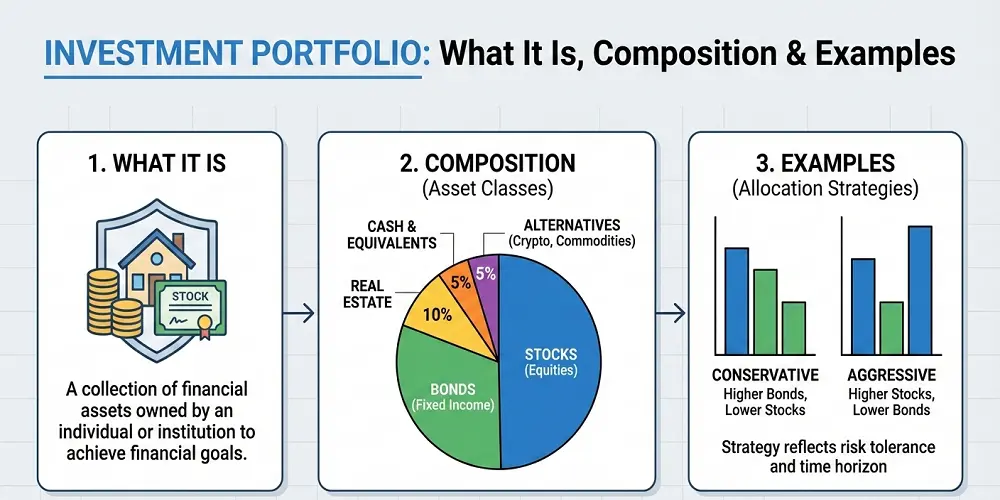
An investment portfolio is a combination of financial assets with the idea of generating a capital gain.
Investment portfolio: A simple explanation
More broadly, we call an investment portfolio or securities portfolio the set of assets in which we have invested money in a diversified manner ; that is, it is the basket of assets in which we are invested. This portfolio can include things like company shares, investment funds, and even gold or currencies.
The advantage of diversification, that is, not putting all your eggs in one basket, is that it reduces the risk of losing money. Some investments will be safer but with lower potential returns (like fixed income ), while others can fluctuate significantly in value but offer the possibility of higher gains, like equities. Some people prefer to have a mix of both types, to balance security with potential returns.
Composition of an investment portfolio
The composition of a portfolio is determined by the investor’s profile, which can be conservative, moderate, or aggressive, depending on the level of risk and volatility the investor is willing to accept. The final return obtained will also depend on the composition of the securities or investment portfolio, based on the proportional weight of each asset within the portfolio.
We can distinguish two types of portfolio based on the time frame of the assets:
- Loan portfolio : This is the portfolio in which we maintain the investment for a long time, aimed at achieving long-term profitability.
- Debt portfolio : If we decide to invest in short-term assets, so called because they are generally borrowed to buy and sell the assets quickly.
Example of a stock portfolio
Investment portfolios can contain many different types of assets, such as bonds, futures, mutual funds, CFDs, and stocks, among other financial assets. However, they can also consist of only one type of asset. For example, a portfolio composed solely of stocks would look like this:
Portfolio Composition
- Stock A (Tech company): ₹50,000 invested
- Stock B (Banking company): ₹30,000 invested
- Stock C (Pharma company): ₹20,000 invested
Total Investment: ₹1,00,000
Step 1: Estimate Probability of Loss
Based on market analysis:
- Probability of market downturn in a year: 25% (0.25)
Step 2: Estimate Impact (Potential Loss)
If the market falls:
- Expected loss: 20% of portfolio value
- Loss amount = 20% of ₹1,00,000 = ₹20,000
Step 3: Calculate Risk
Risk = Probability × Impact
= 0.25 × ₹20,000
= ₹5,000
👉 This means the expected annual risk (expected loss) of the portfolio is ₹5,000.
Additional Risk Measures Used in Stock Portfolios
- Standard Deviation: Measures volatility of returns
- Beta: Measures risk relative to the market
- Diversification: Reduces unsystematic risk
Key Takeaway
Even though a portfolio may lose ₹20,000 in a bad year, the expected risk is ₹5,000 when probability is considered.
