

Key points
- Risk is the possibility that the results will not be as expected.
- Volatility indicates how quickly and how much the value of an investment can change, helping to measure risk.
- In the world of investing, high risk can mean greater potential for profit, but also for loss.
What is risk?
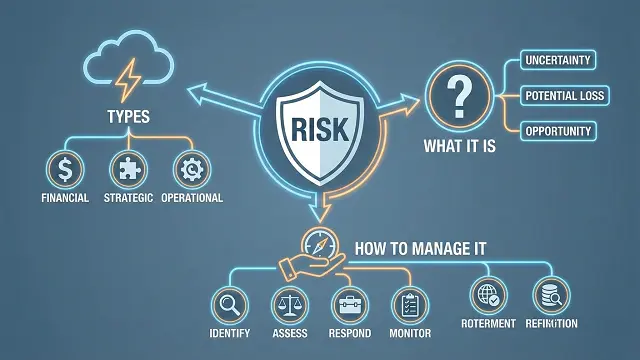
Risk is the uncertainty generated by the evolution and outcome of a specific event. This event can encompass any area.
The risk: A simple explanation
Put more simply, risk is essentially the possibility that things won’t go as planned. This can happen in any situation in our lives, from flipping a coin without knowing whether it will land on heads or tails, to more complex decisions like investing money in a business.
Volatility is another important word when we talk about risk. It refers to how much things change over a period of time. If the value of something you bought, like shares in a company, goes up and down a lot, that means it’s very volatile. If it changes very little, it’s less volatile.
Therefore, volatility gives us an idea of how risky something can be; the more volatile, the more uncertain the outcome.
So, in short, risk means not knowing for sure what will happen, and volatility shows us how much things could change. Understanding these concepts helps us make better decisions, especially when they involve money or investments.
How is it calculated?
Although risk is often viewed negatively, it’s essential to identify it if we want to analyze investments or similar transactions realistically. The investment triangle, for example, is based on risk, liquidity , and return .
In a perfectly competitive market , it’s impossible to find an investment with all three factors optimized to the maximum. In other words, you always have to sacrifice one to obtain a value from the other two that seems reasonable.
In this field we find systematic risk and specific risk, which together make up the total risk of an asset.
On the one hand, the systematic refers to those who have in common assets with one or more common characteristics, whether it be the business sector, the geographical area or other factors.
On the other hand, the specific one tries to reflect the individual nature of that particular asset given its own characteristics.
In summary, while systematic risk is very difficult to avoid, specific risk can be mitigated by diversifying investment options.
Basic Risk Formula
Risk = Probability × Impact
- Probability (Likelihood): How likely the risk is to occur
- Impact (Consequence): The severity of loss or damage if it happens
Common Risk Calculation Methods
- Qualitative Risk Assessment
- Uses ratings like Low, Medium, High
- Often shown in a risk matrix
- Useful when exact data is unavailable
- Quantitative Risk Assessment
- Uses numerical values
- Example:
If probability = 20% (0.2) and impact = $50,000
Risk = 0.2 × 50,000 = $10,000
- Risk Score Method
- Risk Score = Likelihood (1–5) × Impact (1–5)
- Higher score = higher priority risk
- Financial Risk Models
- Methods like Value at Risk (VaR), Expected Loss, or Monte Carlo simulation
- Used in finance, insurance, and large projects
Why Risk Calculation Matters
- Helps prioritize threats
- Improves planning and control
- Supports informed decision-making
If you want, I can explain risk calculation with a real-world example (business, finance, or project management).
Types of risk
There are many types, from labor and legal issues to technological and environmental ones. However, in the business world, they can be divided into internal and external.
On the one hand, internal risks are those generated by the company itself, and it is up to the company to mitigate them or have some control over them. Some examples include those related to operations (human error), business lines (lack of diversification in the range of products for sale), or suppliers ( having one or a few suppliers can leave us in a somewhat vulnerable position for future negotiations).
On the other hand, there is also the external one, which is the most complex to control since its evolution does not depend on the company itself.
Financial risks
- Financial risk:
- Market risk : This is the risk that arises from market-related agents, such as investors, customers, suppliers, competitors, etc. Furthermore, this type of risk affects price fluctuations in financial instruments such as bonds, stocks, etc. It also directly impacts the risk factor of an investment.
- Liquidity risk : This is the degree of difficulty in converting an asset into cash. It affects the liquidity factor in the investment triangle and is closely related to companies’ sources of financing.
- Credit risk : This refers to the possibility of incurring losses if a company’s customers are late in making payments or fail to pay altogether. It is one of the most common risks associated with a company’s financial assets.
- Business risk:
- Strategic risk: This is related to strategic decision-making, such as entering new markets or launching new products.
- Operational risk: Involves internal problems in the management of a company, such as supply chain management, cybersecurity, or human resource management.
- Reputational risk: In this case, the risk consists of the exposure to which a company is subjected at the level of social networks and public opinion.
- Legal and regulatory risk: This refers to the risk that legislation may change and negatively affect us, either directly or indirectly. Therefore, companies must take this risk into account to mitigate any potential negative consequences.
- Market risk:
- Exchange rate and interest rate risk : This refers to the interest rates set by central banks and their respective governments. These rates can lead to inflation or deflation and negatively impact a company’s results. This affects profitability within the investment triangle.
- Commodity price risk: Related to variations in the prices of raw materials such as oil, gold, and food.
- Real estate market risk: This is associated with fluctuations in real estate and property prices.
- Personal risk:
- Health risk: Includes illnesses, injuries, or health problems that may affect a person.
- Life risk: This refers to situations that endanger a person’s life, such as serious accidents.
- Security risk: Covers threats to personal safety, such as robberies, assaults or attacks.
- Longevity: linked to uncertainty about how long a person will live and how they will support themselves financially in retirement.
- Other risks:
- Force majeure : This refers to the unpredictable risk of catastrophes or natural disasters that could affect the company. This type of risk is unavoidable for businesses. However, it must always be taken into account when establishing operations in a location prone to such hazards.
- Technological: This refers to problems related to technology, such as cyberattacks, failures in computer systems, or disruptive technological changes.
As you can see, there are many risks. Some depend on the company’s internal performance, while others are external factors. These latter risks can cause the most problems if contingency plans aren’t in place for unforeseen events. From an accounting perspective, contingency reserves are typically used. However, from a financial perspective, diversification is often a good tool for mitigating the inherent market risk.
Risk management
When assessing business risks, it’s crucial to know how to identify and mitigate them. Risk management is the tool companies use to identify, analyze, and proactively respond to the various problems they may encounter.
With effective risk management, companies can detect any potential problems and mitigate them, allowing them to continue operating effectively and achieve their objectives. This process should be carried out regularly, incorporating continuous improvements to enhance the procedure and the speed of results.
A risk management plan, apart from helping you deal with risks, lets you know the optimal risk levels for a company, improve capital allocation, protect the company’s corporate image, etc.
Difference between risk and danger
To understand this concept correctly, we must know how to differentiate it from the concept of danger.
The main difference between the two concepts is that danger refers to an act or situation that can cause potential harm, while risk refers to the probability of a dangerous event occurring and the severity of its consequences.
To illustrate the differences between these two concepts in a work context, we can refer to a kitchen. For example, working in the kitchen with knives or hot oil inherently involves danger.
But the risk of cuts or burns (probability of being cut or burned) will be different for a cook who is using, for example, the necessary clothing than for one who does not comply with risk prevention regulations.
Furthermore, the severity of the risk will also differ depending on whether the cook is working close to the oil or with very sharp knives compared to other cooks who are further away from the oil or who use non-cutting utensils.
Examples
Below are some examples of risks:
- Occupational risk: Any risk that could cause an accident during working hours. An example would be if a cook were to accidentally burn or injure themselves with a kitchen utensil.
- Technological risk: Any risk related to a technological component. An example is the risk incurred if a company stores all its data on hard drives, which can be subject to cyberattacks.
- Environmental risk: This refers to the possibility of unforeseen events occurring, either from our company’s impact on the environment or from the environment’s impact on our company. Spills of toxic substances or damage to company assets by animals are clear examples, respectively.
- Solvency risk: In this case, an example would be the risk assumed by a financial institution when lending us money, since a possible default may occur.
These are some examples of the different types of risks that exist, although they are not the only ones that can occur.
